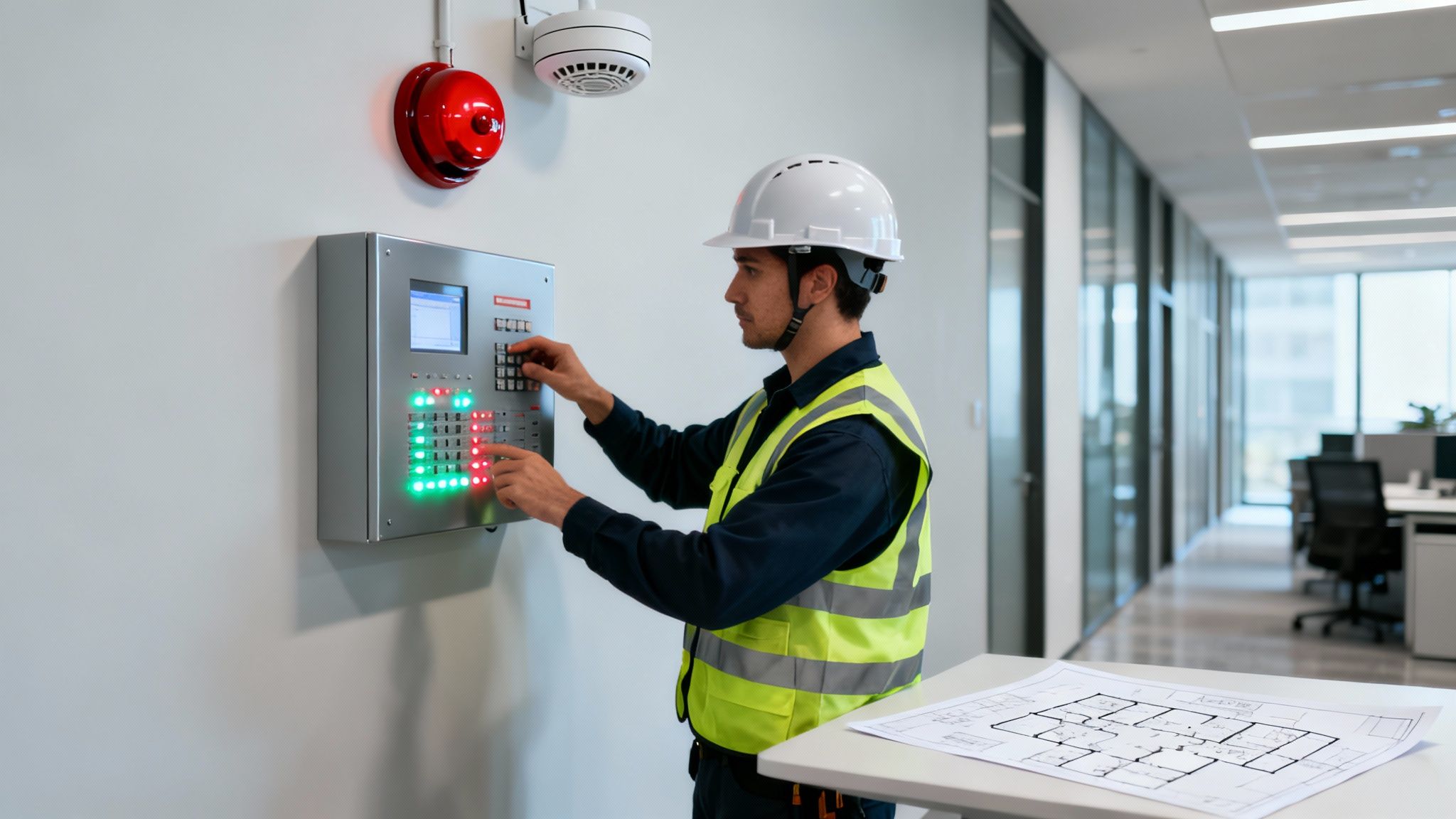
Installing a commercial fire alarm system isn't just another job for the maintenance list. It's a highly regulated, specialist process that follows strict UK safety standards like BS 5839-1, covering everything from the initial site survey and design to the final commissioning. This is a critical life-safety system designed to protect people and property, which is precisely why it's a job for certified experts, not a task for a general electrician or a weekend DIY project.
Why Professional Installation Is Your First Line of Defence
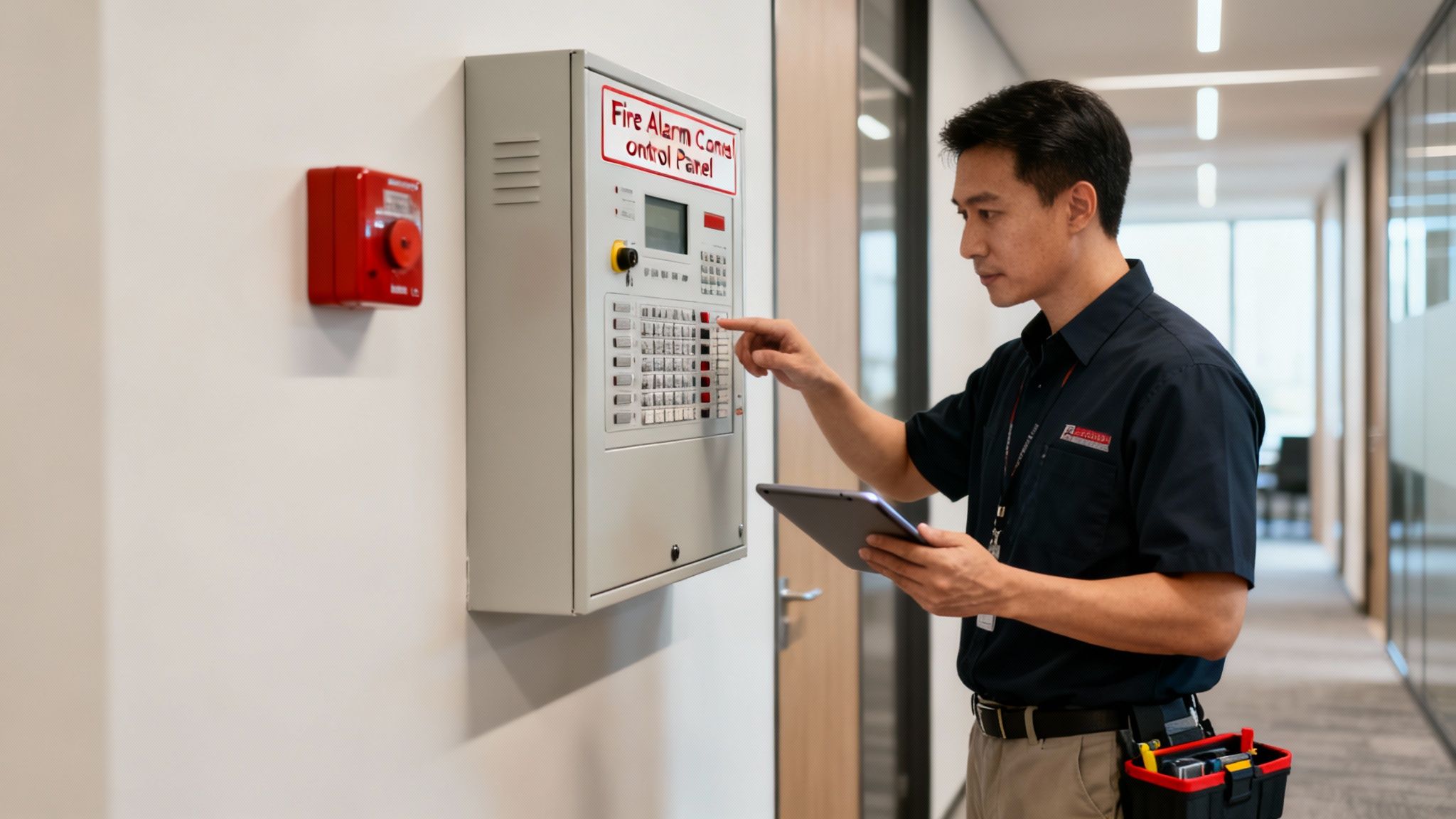
Think of your fire alarm system as the building's nervous system. It’s not just a box on the wall with some detectors scattered around; it's a carefully designed, interconnected network with one vital job: to give everyone the earliest possible warning when a fire breaks out. When every second counts, a professional installation ensures this system works perfectly, without a single point of failure.
For any facilities manager or business owner, the duty of care goes far beyond ticking a box on a compliance form. It’s about creating an environment where staff, visitors, and customers are genuinely safe, and the business itself is protected from catastrophic disruption. An expertly installed fire alarm system is the bedrock of that resilience.
The True Cost of Cutting Corners
Tempted to save a few pounds by using an unaccredited installer? It's a gamble with dangerously high stakes. An improperly designed or poorly installed system is a disaster waiting to happen, riddled with potential for delayed alerts, silent sounders, or a complete system blackout in an actual fire. The fallout isn't just financial; it opens you up to severe legal liability and, worst of all, puts lives at risk.
A professional, certified installation gives you certainty. You get:
- Full Compliance: Peace of mind knowing your system meets the complex requirements of UK standards like BS 5839, sidestepping hefty fines and legal issues.
- Flawless Performance: Detectors and alarms placed exactly where they need to be for maximum coverage, leaving no dangerous blind spots.
- Fewer False Alarms: A properly calibrated system with high-quality components means fewer disruptive—and costly—false alarms that lead to downtime and complacency.
- A System That Grows With You: A smart, scalable design that can adapt as your building's layout changes or integrate with other security systems down the line.
A professionally installed fire alarm system is your first, and best, line of defence. It transforms a passive building into an active guardian, constantly monitoring for threats and ready to react instantly to protect what matters most.
Finding a Credible Partner
Choosing your installation partner is just as critical as choosing the system hardware. Much like with other security systems, the process of finding a certified installer you can trust is about identifying a team that understands the unique risks and layout of your building.
This guide will walk you through the entire process, from making sense of the regulations to understanding the technology that will keep your premises safe. We'll show you why a professional commercial fire alarm installation is a non-negotiable investment in your business's continuity and your own peace of mind.
Getting to Grips with UK Fire Safety Regulations
When it comes to commercial fire alarms, understanding the UK's legal framework isn't just a box-ticking exercise. It's the absolute foundation for protecting lives and your property. These aren't suggestions; they are firm legal duties. Getting it wrong can lead to hefty fines, voided insurance policies, and, most critically, a system that lets you down when it matters most.
The main piece of legislation you need to know is the Regulatory Reform (Fire Safety) Order 2005. This law makes it crystal clear that a specific 'Responsible Person' in any business or non-domestic building has the legal duty to manage fire safety. That means carrying out a thorough fire risk assessment and ensuring all the right fire precautions, including a suitable alarm system, are in place and working correctly.
Why British Standard BS 5839-1 is Your Rulebook
If the Fire Safety Order tells you what to do, BS 5839-1 is the detailed instruction manual that explains how to do it. Think of it as the definitive "code of practice" for designing, installing, and maintaining fire alarm systems in the UK. Any reputable installer will live and breathe this standard.
It covers everything from where to place detectors and what type of cable to use, right through to how the system should be tested. Sticking to BS 5839-1 is universally seen as the best way to prove you’re meeting your legal obligations under the Fire Safety Order. It ensures your system is genuinely fit for purpose, based on the real-world risks in your building.
What Do the Different Fire Alarm Categories Mean?
One of the first things you'll encounter in BS 5839-1 is the concept of System 'Categories'. These are simply a way of classifying how much protection a system provides, a bit like different levels of insurance cover. They fall into two main groups, depending on whether the priority is protecting people or property.
A detailed fire risk assessment is what ultimately dictates the category your building needs. A professional designer will use that assessment as their blueprint to create a compliant system that’s right for your business.
To make this clearer, here's a simple breakdown of what each category means and where you might find it.
UK Fire Alarm System Categories Explained (BS 5839-1)
A simplified breakdown of the primary fire alarm system categories to help you understand the level of protection each provides.
| Category | Primary Goal | Typical Application |
|---|---|---|
| L1 | Maximum Life Protection | Hotels, care homes, large offices where early warning in all areas is critical for evacuating people safely, especially those who may be sleeping. |
| L2 | Additional Life Protection | Office blocks or factories where there are specific high-risk areas (like a kitchen or plant room) plus the main escape routes need protecting. |
| L3 | Standard Life Protection | Most small-to-medium offices and commercial buildings. The focus is on ensuring all escape routes and the rooms leading onto them are covered. |
| L4 | Escape Route Protection | A more basic level of protection, covering hallways, corridors, and stairwells only. Found in lower-risk premises. |
| L5 | Localised Protection | A special category for protecting a specific, high-risk piece of equipment or area, such as a large server room or a generator. |
| P1 | Maximum Property Protection | Warehouses, data centres, or museums where the goal is to summon the fire brigade at the earliest possible moment to minimise damage to the building and its valuable contents. |
| P2 | Defined Property Protection | Protects specific, defined areas of a building that are critical to business operations or contain high-value assets. |
Understanding these categories is vital because it directly links the level of investment and system complexity to the real-world risks your organisation faces.
And the pressure to get this right is very real. In the year ending March 2025, Fire and Rescue Services in England carried out 51,020 fire safety audits—a 2.4% increase on the previous year. With only 58% of audited premises found to be satisfactory, it’s clear that many businesses are falling short. These figures underscore just how crucial a professionally designed and installed commercial fire alarm is. You can read more about these fire safety audit findings from the Home Office.
The Critical Role of Site Surveys and System Design
A truly effective fire alarm system isn't something you can just pull off a shelf. Before a single wire is pulled or a detector is screwed to the ceiling, the real work begins with a thorough site survey and risk assessment. This is the diagnostic stage that lays the foundation for a system that’s not just compliant, but genuinely fit for purpose in your specific building.
Think of it like a doctor’s check-up before prescribing treatment. The survey is a deep dive into your property’s unique characteristics, identifying potential fire hazards, understanding how people move through the space, and noting the specific risks tied to different areas. It’s far more than a quick walkthrough; it’s a strategic analysis that shapes every decision that follows.
Mapping Out Your Building’s DNA
A professional site survey goes well beyond measuring rooms. It’s about pinpointing high-risk zones that demand special attention, like a commercial kitchen with high heat and steam, a server room full of sensitive electronics, or a workshop where dust and fumes are part of the daily routine. Each of these environments could easily trigger false alarms or, worse, require a very specific type of detection to be effective.
The survey meticulously maps out:
- Occupancy and Use: How many people are in the building each day? What are their movement patterns? A busy theatre has completely different evacuation needs compared to a quiet office block.
- Escape Routes: Every primary and secondary escape route is identified to ensure sounders and detectors provide clear, unambiguous warnings all the way to safety.
- Building Structure and Materials: The building's age, construction, and layout heavily influence the system design. A modern, open-plan warehouse poses different challenges to a historic listed building with thick stone walls that could block wireless signals.
This process gives you a clear picture of the UK's regulatory journey, from the overarching law to final compliance. Getting these steps right is fundamental.
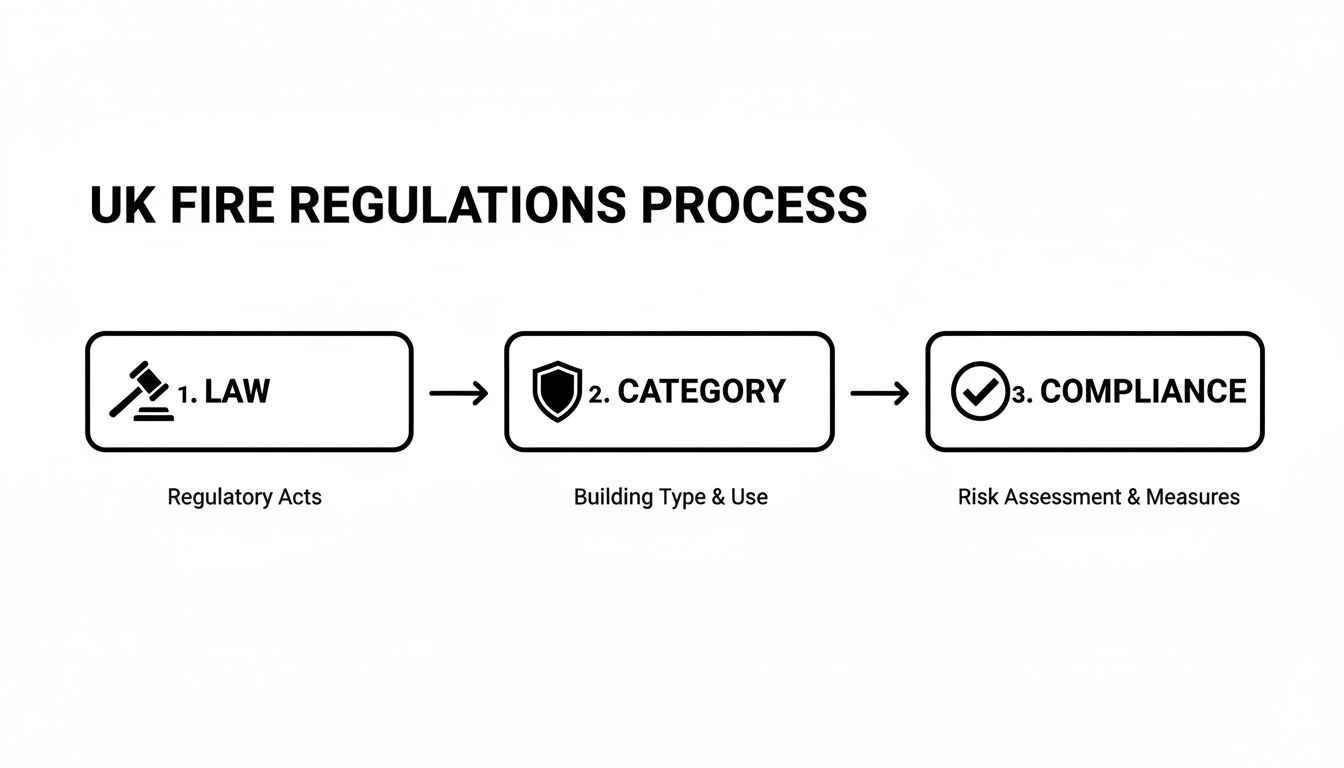
The image above breaks down how compliance is a structured process. It all starts with the law (the Fire Safety Order) and flows into selecting the right system category based on your building's risk profile.
Translating Insights into Intelligent Design
All the information gathered during the site survey becomes the blueprint for the system design. This is where expertise comes in, turning those identified risks into a practical, life-saving solution. The design specifies not just what components to use, but precisely where to put them and why.
The goal of system design is to create a seamless web of detection that leaves no blind spots. Every detector, call point, and sounder is placed with purpose, guided by the findings of the risk assessment to ensure the earliest possible warning.
This is also where key technology decisions are made. For a small, simple layout, a conventional system might be perfectly adequate. But for a large, complex facility, an addressable system that can pinpoint the exact location of a fire is essential. And for a listed building where running new cables is out of the question, a wireless system is the only logical choice.
Each decision is a direct response to the specific needs uncovered during the survey. To make sure your design is robust and fully compliant, getting expert help through professional consultancy and design services is a vital step.
Ultimately, the final design document is the installer's bible. It dictates the precise placement of every smoke detector, heat sensor, and manual call point, ensuring total coverage, minimising false alarms, and guaranteeing the system performs exactly as it should when it matters most. Without this groundwork, even the most advanced hardware is just an expensive guess.
Choosing the Right Fire Alarm Technology for Your Building
Once your site survey is done and you have a clear design in hand, it’s time to get into the nuts and bolts of the technology itself. This isn't just about picking the priciest kit off the shelf; it's about making a smart match between the system's brainpower and your building's unique character, your budget, and where you see things heading in the future. Get this part right, and you'll have a system that not only keeps you safe today but is ready for whatever tomorrow throws at it.
The world of fire alarms really boils down to three main types: conventional, addressable, and wireless. Each has its place, and understanding the core differences is the key to making a decision that gives you the best balance of cost, performance, and compliance.
Conventional Fire Alarm Systems
Think of a conventional system as the straightforward, no-frills option. It works by splitting your building into broad areas called 'zones'. All the detectors in one zone—say, the entire ground floor—are wired together on one circuit. If a detector goes off, the main panel tells you there's a problem in that zone, for example, "Fire Alarm – Zone 1 (Ground Floor)".
It points you to the general vicinity of the fire but won't tell you exactly which device has been triggered. For smaller, less complex buildings like a local shop or a small office, this is often perfectly adequate. It's a reliable, cost-effective solution. The downside? In a larger building, you could lose precious minutes trying to pinpoint the exact source of the alarm.
Addressable Fire Alarm Systems
This is where things get much smarter. Addressable systems, often called 'intelligent' systems, give every single device on the network its own unique digital 'address'. Your smoke detector in the server room, the heat detector in the kitchen, and the call point by the main exit—they all have a name.
When a device activates, the control panel tells you precisely where the problem is: "Smoke Detector – Server Room, First Floor". This kind of pinpoint accuracy is a game-changer in complex sites like hospitals, universities, or sprawling office blocks. It means firefighters and your own team can head straight to the source, slashing response times when every second counts.
An addressable system turns a simple alarm into a detailed diagnostic tool. It gives you the crucial "where," not just the "what," leading to a faster, more targeted, and ultimately safer response.
While the initial hardware costs a bit more than a conventional setup, addressable systems pay you back with easier expansion, better system monitoring, and a much greater ability to weed out false alarms using clever software.
Wireless Fire Alarm Systems
Wireless systems deliver all the intelligence of a wired addressable system, but without the cables. Instead of running wires through walls and ceilings, the detectors, sounders, and call points talk to the control panel using secure radio signals. This makes them a fantastic solution for buildings where pulling new cables is a nightmare, or even forbidden.
Think about these situations where wireless really comes into its own:
- Listed and Historic Buildings: When you can't drill into 200-year-old plasterwork, wireless is the only way to protect a building's architectural soul.
- Temporary Installations: Perfect for construction sites or pop-up venues that need full fire safety without the permanent infrastructure.
- Complex or Delicate Interiors: In buildings with solid concrete walls, ornate ceilings, or high-end finishes, a wireless install avoids huge disruption and cost.
The UK fire alarm market is set to grow at a 7.0% compound annual rate through 2031, and a lot of that growth is coming from the shift to smarter, addressable systems. Wireless technology is gaining real momentum because it's so much less disruptive, while AI-powered detection is helping tackle the costly problem of false alarms. You can get a deeper dive into these UK fire alarm industry updates and trends.
Selecting the Right Detectors
Beyond the type of system, you need the right 'noses' to sniff out trouble. Choosing the correct detectors is vital. The main players are:
- Smoke Detectors (Optical/Ionisation): Your bread-and-butter detector. They’re excellent at picking up the slow, smouldering fires that produce a lot of smoke.
- Heat Detectors: These are for places where smoke, steam, or dust are part of daily life, like kitchens or workshops. They react to a sharp spike in temperature, not particles in the air.
- Multi-Sensor Detectors: Frankly, this is the new standard for any modern commercial fire alarm installation. These clever devices combine smoke and heat sensors with an onboard brain, often using AI algorithms, to analyse the situation. This dual-check approach allows them to tell the difference between a genuine fire and burnt toast, which dramatically reduces false alarms.
Creating a Fully Integrated Safety Ecosystem
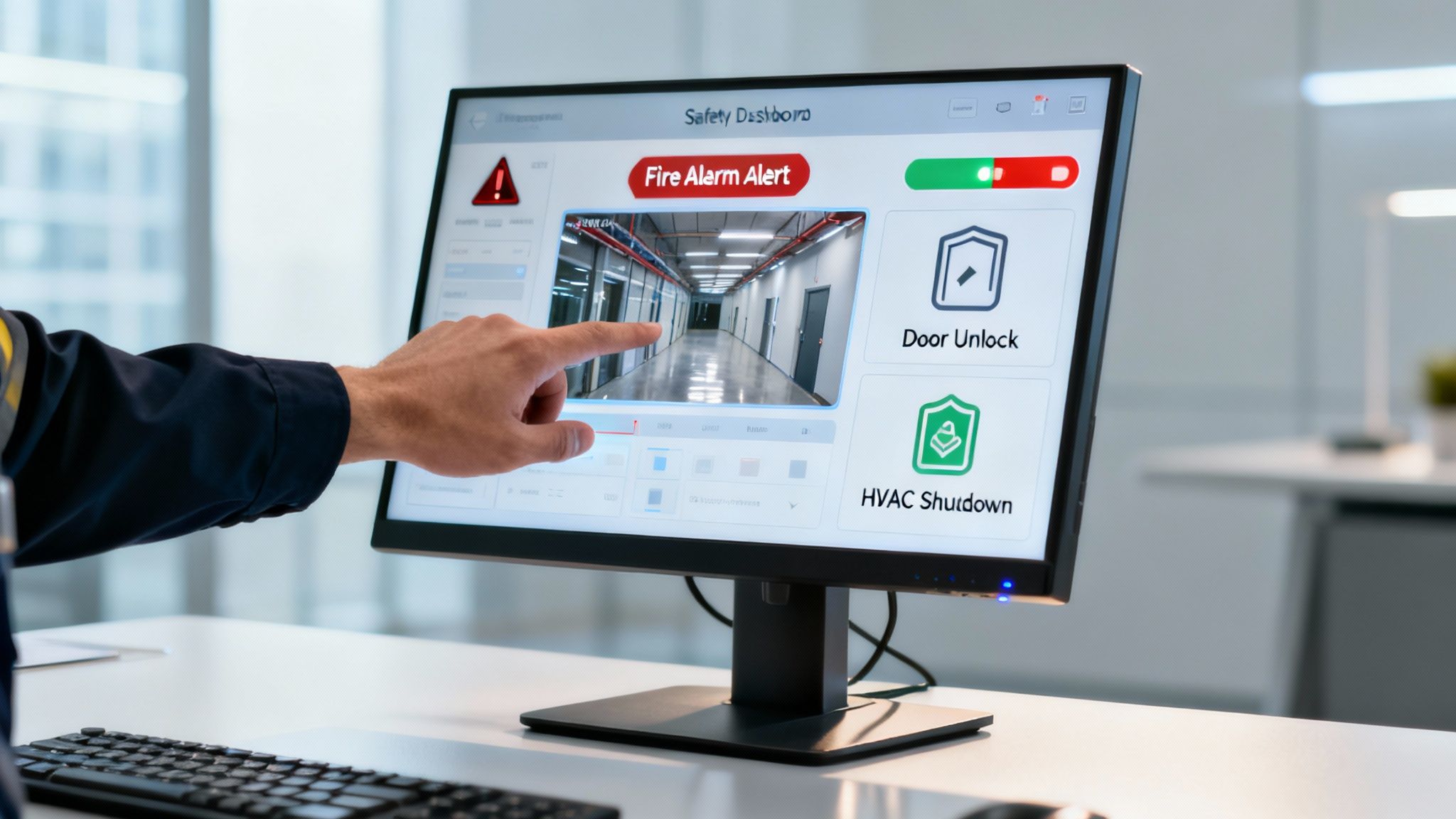
A fire alarm system sitting on its own is a missed opportunity. The truth is, the most effective fire protection today doesn't operate in a silo. It acts as the nerve centre for a much broader, interconnected life-safety network, transforming your building’s defences from a jumble of separate parts into one intelligent, cooperative ecosystem.
Think of it like an orchestra. In a disconnected setup, the fire alarm might sound, but the ventilation keeps fanning the smoke and the security doors stay stubbornly locked. When everything is integrated, however, every component works from the same sheet music. The moment a threat is detected, you get a perfectly synchronised and automatic response.
How Different Systems Work Together
When your fire alarm can 'talk' to other building management systems, you unlock powerful, automated safety protocols that can genuinely save lives. This coordinated action is worlds away from what any single system could achieve on its own.
Here’s how it works in practice:
- Access Control Systems: The moment a fire is detected, the system can automatically unlock emergency exits and release mag-locks. This ensures escape routes are clear for a swift and orderly evacuation, without anyone fumbling for a keycard.
- CCTV Systems: The alarm panel can instantly command nearby cameras to pivot towards the affected zone, giving first responders a live video feed. This is invaluable for situational awareness, allowing them to see what they're walking into before they even set foot inside.
- HVAC Systems: Integration can trigger an immediate shutdown of ventilation and air conditioning. This is absolutely critical for stopping smoke and toxic fumes from being rapidly circulated throughout the building via the ductwork.
It’s no surprise that this joined-up approach is what businesses are now demanding. The UK security systems services industry, which handles these integrated solutions, has seen a steady 4.7% compound annual growth over the past five years. It's now valued at an estimated £1.9 billion, a figure that clearly shows the shift away from old-fashioned, standalone alarms.
The Power of a Unified Dashboard
For any facilities manager, one of the biggest wins from an integrated system is centralised command. Forget jumping between different screens for fire, security, and access control. Instead, you get a single, intuitive dashboard. From one place, you can monitor alerts, check camera feeds, and manage access points, giving you a crystal-clear overview as a situation unfolds.
This unified command centre changes your role from reactive to proactive. You’re no longer just hearing an alarm; you’re managing a coordinated event with complete visibility. To see how a professional installer makes this happen, take a look at our guide on security system integration.
By linking disparate systems, you create an intelligent building that actively participates in its own protection. It’s a strategic shift from simple detection to automated, intelligent response.
This comprehensive strategy should also include physical fire containment. When designing a truly integrated ecosystem, vital elements like fire shutters for windows can be linked to automatically deploy when the alarm triggers, helping to compartmentalise and control a blaze. Pulling all these threads together requires a specialist installer with proven expertise in creating these unified safety platforms.
Life After Installation: Keeping Your System Fighting Fit
Getting your new commercial fire alarm system installed and signed off is a huge step, but it’s really just the beginning of the journey. A fire alarm isn't a "fit and forget" appliance; its ability to save lives and protect your property hinges on a solid programme of ongoing maintenance and testing. This isn't just good practice—it's a legal requirement under UK law, specifically BS 5839-1.
Within your organisation, one person is designated the ‘Responsible Person’. It’s their job to make sure the system is always in perfect working order, ready to spring into action. This means sticking to a strict schedule of checks, blending your own team's weekly duties with the deep expertise of specialist engineers.
Your Routine Testing Schedule
Think of effective maintenance as a partnership between your in-house team and your certified fire safety company. While a quick daily glance at the main panel for any fault lights is a great habit, the official requirements are more structured.
- Weekly User Tests: Every week, without fail, you need to test at least one manual call point. You should rotate which one you test each time to ensure they all get checked. This simple action confirms that the signal reaches the control panel and that the sounders actually work. It’s your first and most important line of defence.
- Bi-Annual Engineer Servicing: A qualified engineer must carry out a full, in-depth service twice a year. This is far more than just a quick sound test. They'll dig into everything from battery health and detector sensitivity to checking the integrity of every last wire and connection.
It helps to think of it like an MOT for your fire alarm. Your weekly tests are like checking your car's oil and tyres—basic but essential. The bi-annual service is the full garage inspection that catches hidden problems before they become catastrophic failures.
The Power of 24/7 Remote Monitoring
Regular testing confirms your system can work, but what happens if a fire breaks out when nobody is on-site? An unmonitored alarm blaring away in an empty building at 3 a.m. is a lonely, useless sound. It makes a lot of noise, but it doesn't actually call for help.
This is where 24/7 monitoring proves its worth.
When a monitored system is triggered, a signal is instantly fired off to a dedicated Alarm Receiving Centre (ARC). There, trained operators immediately verify the alarm. If it's genuine, they dispatch the fire brigade—day or night, weekend or bank holiday. This guarantees a rapid, professional response, dramatically cutting the time it takes for help to arrive and limiting the potential for devastating damage. It turns your alarm from a simple local warning into a direct line to the emergency services.
You’ve invested in a professional system; it makes sense to protect that investment with a robust servicing plan. To keep your system compliant, reliable, and ready for anything, exploring your options for commercial security system maintenance is the critical next step. Proactive care isn’t just about ticking legal boxes—it's about maximising your system's lifespan and giving you genuine peace of mind.
Common Questions About Commercial Fire Alarm Installation
Getting a new fire alarm system installed always comes with questions. It's a critical investment, and you need to know you're making the right choices for your people, property, and legal obligations. Let's tackle some of the most frequent queries we hear from facilities managers and business owners.
How Long Does an Installation Take?
There's no one-size-fits-all answer here; it really depends on the building. For a small office getting a simple wireless system, we could be in and out in just a few days with very little disruption to your team.
On the other hand, a large, complex site like a hospital wing or a multi-storey hotel is a different beast entirely. A fully hard-wired, addressable system in a building like that is a project that could easily span several weeks. The only way to get a firm timeline is with a proper site survey, which lets us map out the work and plan it around your day-to-day operations.
What Causes False Alarms and How Can We Prevent Them?
False alarms are more than just an annoyance; they breed complacency and can lead to hefty fines from the fire brigade. Most are caused by completely avoidable things: steam from a kitchen, dust from building work, or even someone using an aerosol spray too close to a detector head.
The best defence is smart design right from the start.
You wouldn't put a sensitive smoke detector in a steamy kitchen—that's just asking for trouble. A heat detector is the right tool for that job. It all comes down to putting the right type of sensor in the right place.
Regular, professional maintenance is the other half of the battle. Keeping sensors clean, calibrated, and working as they should is non-negotiable. Modern multi-sensor detectors are also brilliant at this, using clever algorithms to tell the difference between cooking fumes and a genuine fire.
What Accreditations Should My Installer Have?
This one is crucial. In the UK, you should never let anyone touch your life-safety systems unless they have third-party certification from a UKAS-accredited body. It’s your guarantee of their competence.
Specifically, you need to be on the lookout for:
- BAFE Certification: Look for the SP203-1 scheme. This covers the full lifecycle of a fire alarm system: design, installation, commissioning, and maintenance.
- NSI (National Security Inspectorate) Gold or Silver: This shows the company not only meets high technical standards but also runs a tight ship with a quality management system.
Think of these certifications as your proof that the company has been independently vetted and is serious about adhering to British Standards. Honestly, choosing an accredited installer is the single most important decision you'll make for a compliant and reliable commercial fire alarm installation.
At Amax Fire & Security Ltd, we provide accredited, end-to-end fire safety solutions designed to meet the highest UK standards. To discuss your project with our certified experts, visit us at https://amaxfireandsecurity.co.uk.