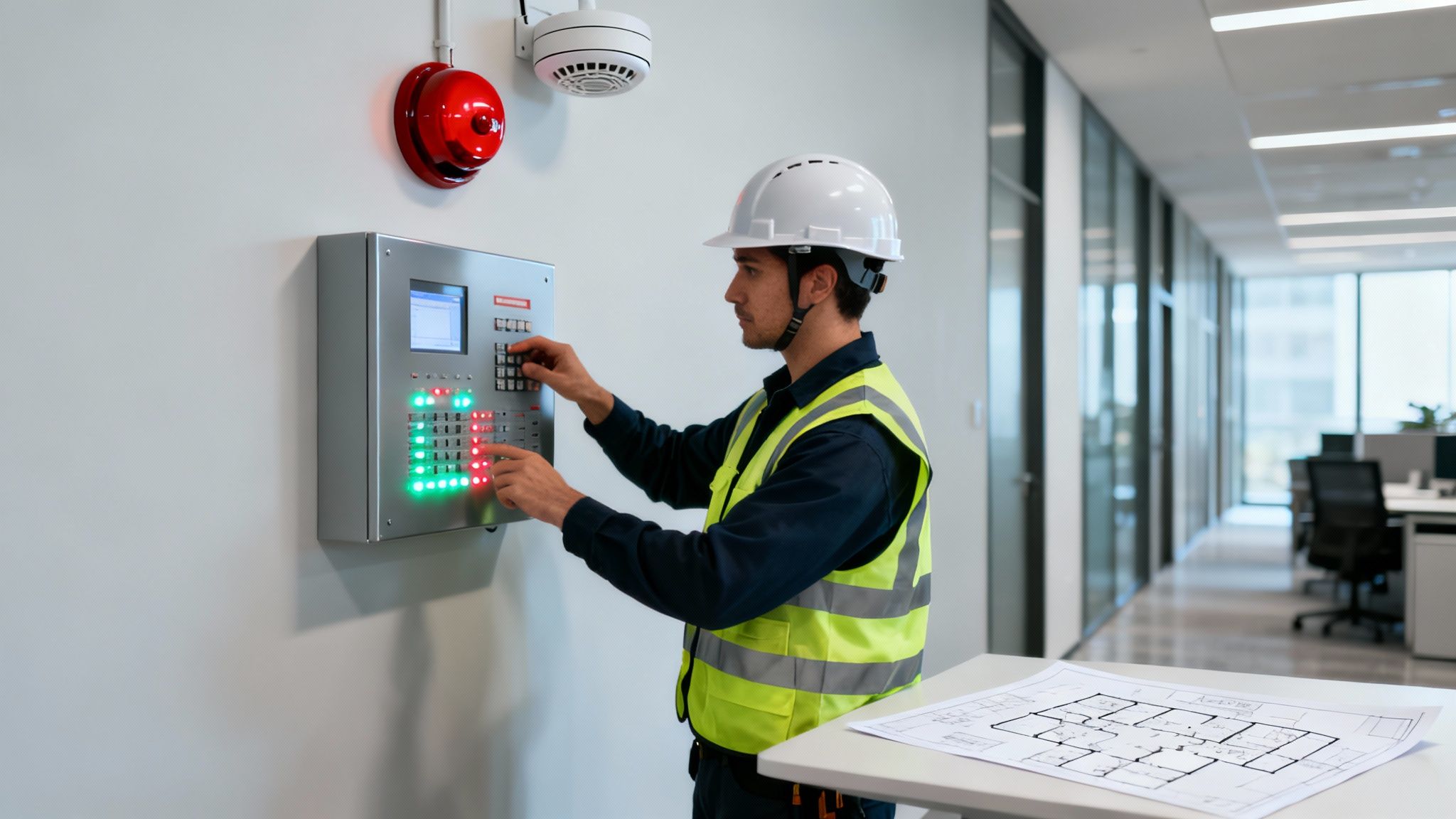
When it comes to installing an intruder alarm, especially in a commercial or high-end residential setting, the debate between DIY and calling in the professionals isn't really a debate at all. For a system to be reliable, compliant, and actually do its job, professional installation is the only way forward. It’s about making sure every single component—from the motion sensors in the corner to the main control panel—is working in perfect harmony, satisfying both your insurer and the relevant British Standards.
Why Professional Installation Is Non-Negotiable
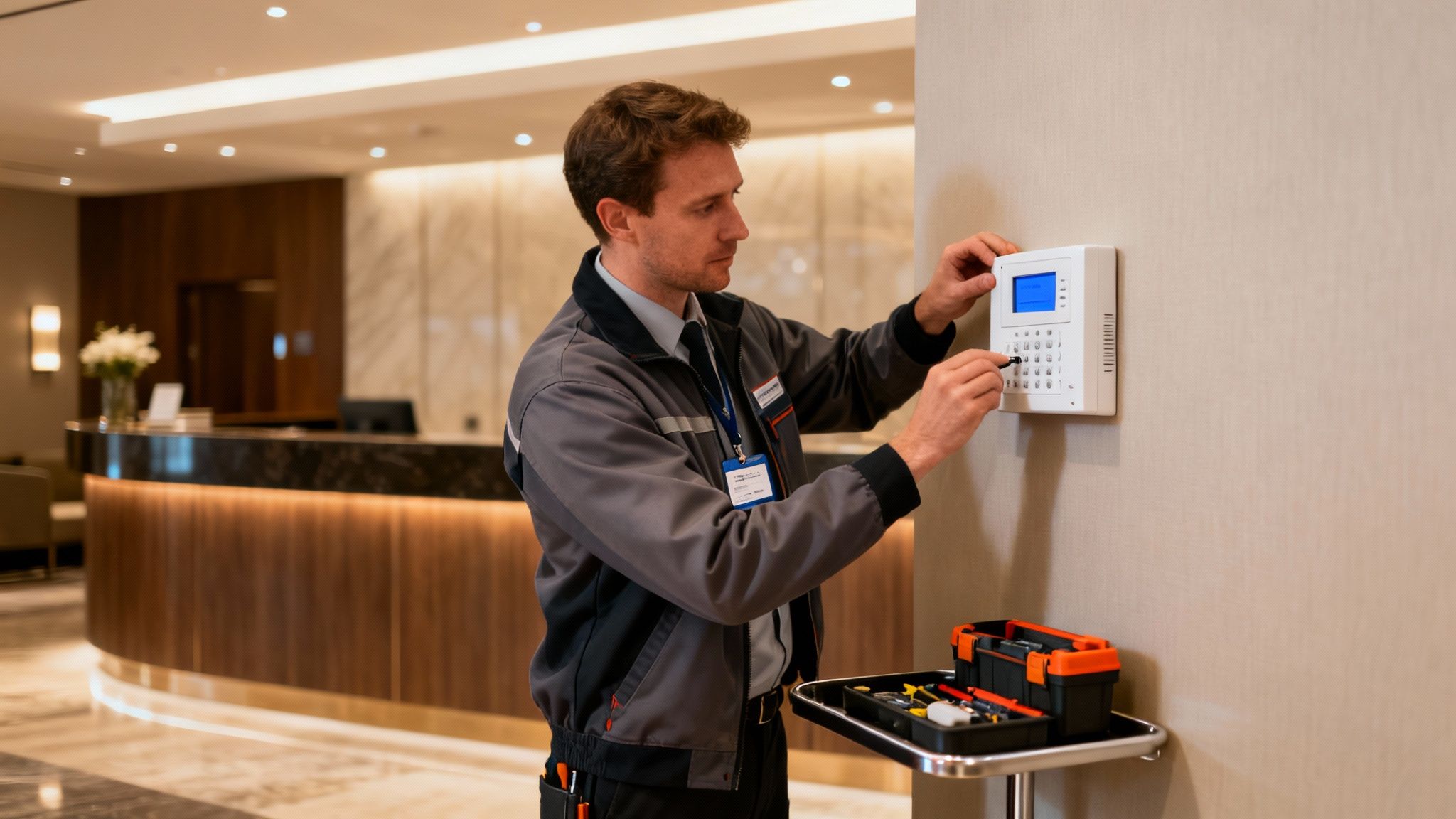
For facilities managers and property developers, an intruder alarm isn't just a box on the wall that makes a noise. It's a critical layer in your overall security strategy. Choosing a professional installer isn't about convenience; it's about certainty. You need to know that the system will perform exactly as it should when a real threat occurs.
A poorly installed alarm is worse than no alarm at all. It gives you a false sense of security while leaving your most valuable assets completely exposed. The risks are magnified when you consider different environments. Securing a bustling hotel with constant foot traffic is a world away from protecting a high-security data centre, and a generic, off-the-shelf approach just won't cut it.
The Real-World Consequences of Cutting Corners
We’ve seen it time and again—a DIY or sub-par installation can backfire spectacularly. Here are a few of the most common pitfalls:
- Insurance Invalidation: Dig into the small print of most commercial insurance policies. You'll often find they demand security systems be installed and maintained by an accredited professional. A self-installed system could easily void your cover, leaving you to foot the entire bill after a break-in.
- Frequent False Alarms: This is a classic sign of a poor installation. Sensors placed too close to a heat source or incorrectly calibrated will trigger constant false alarms. Beyond the disruption, this can lead to police downgrading your response or even issuing fines.
- Compliance Failures: Professional installers live and breathe British and European Standards like PD 6662. Failing to meet these strict requirements can have serious legal and operational consequences, particularly for businesses.
An improperly installed alarm doesn't just fail to protect; it actively creates risk. It’s the difference between a system that genuinely deters criminals and one that offers an open invitation through its obvious flaws.
Understanding the compelling reasons behind professional installation helps frame the investment. It's not just about buying hardware; it's about mitigating tangible risks and ensuring operational continuity.
Core Drivers for Professional Intruder Alarm Installation
| Driver | Impact on Your Organisation | How Professional Installation Helps |
|---|---|---|
| Insurance Compliance | Policies often become void without certified installation, leading to massive financial loss after an incident. | Accredited installers provide a certificate of compliance, guaranteeing your insurance cover remains valid. |
| Police Response | Systems with frequent false alarms can be downgraded, resulting in a delayed or non-existent police response. | Expert calibration and system design minimise false alarms, ensuring a Unique Reference Number (URN) for police response. |
| Regulatory Adherence | Non-compliance with standards like PD 6662 can lead to legal penalties and operational shutdowns. | Professionals ensure every aspect of the system meets or exceeds current regulations, removing legal risks. |
| System Reliability | A poorly installed system is prone to failure, creating vulnerabilities that criminals can exploit. | Quality workmanship, correct component selection, and thorough commissioning guarantee the system works when needed most. |
Ultimately, these drivers highlight that professional installation is a strategic decision, not just a technical one.
This need for expertise is backed by what's happening on the ground. Crime rates in England and Wales saw a 4% increase in the year ending June 2023, with total recorded crimes hitting 6.7 million. This stark reality is driving the demand for robust security solutions, with the industry projected to reach £1.9 billion in revenue through 2025-26. You can explore more data on the UK security market for a deeper look.
This guide will walk you through the proper, professional process, step by step, to ensure your investment delivers genuine security and peace of mind.
Building Your Security Blueprint
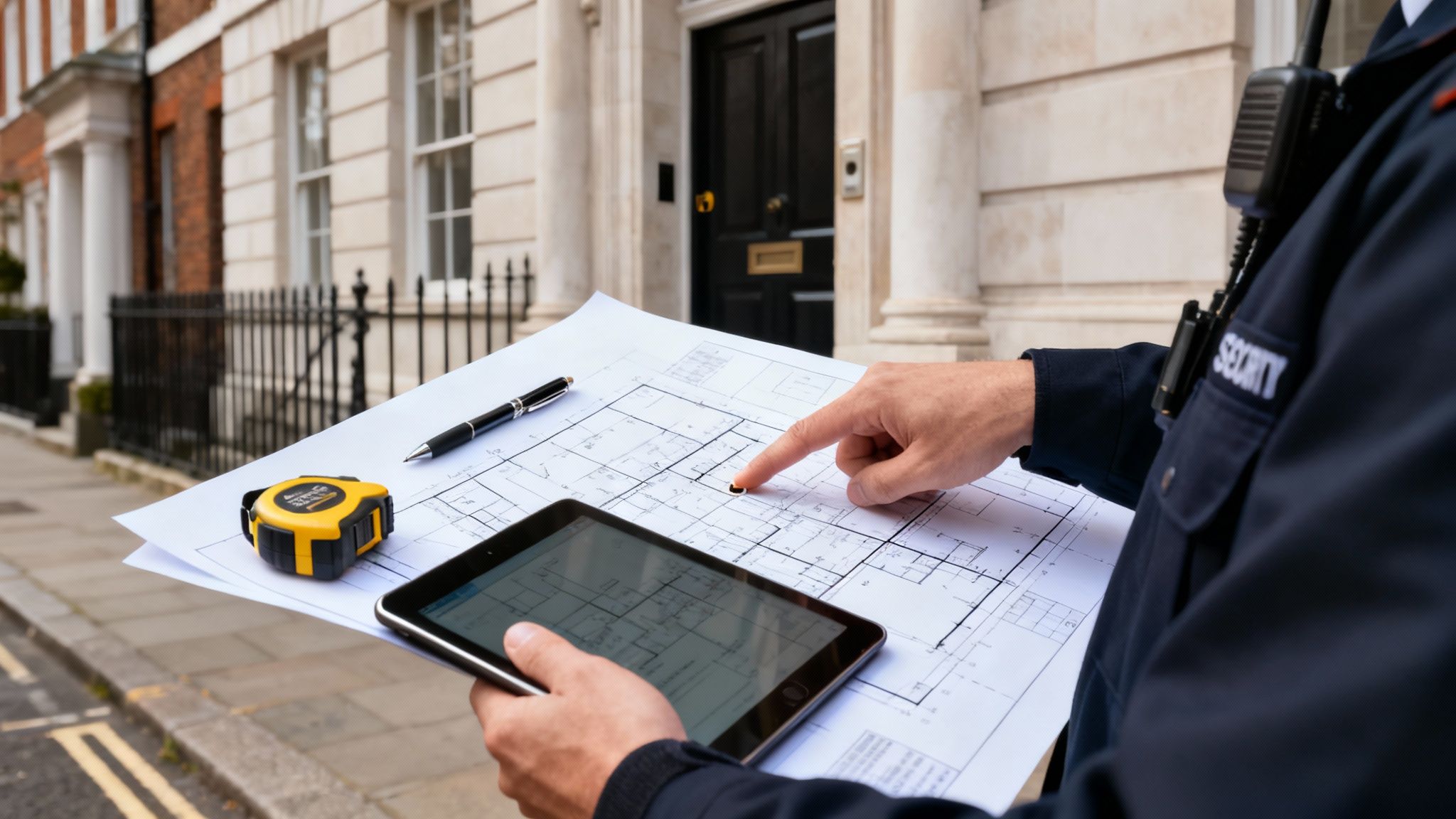
A proper intruder alarm installation isn’t about just sticking a few sensors on the walls and calling it a day. It all begins with a meticulous site survey and a thorough risk assessment—a deep dive that almost always uncovers vulnerabilities you never even knew you had. This is the bedrock of a system built for your specific environment, not some off-the-shelf package.
A professional assessment looks far beyond the obvious doors and windows. We’re talking about analysing how your staff move through the building to spot operational blind spots, mapping out those forgotten access points, and even considering unique environmental factors. The real aim here is to build a complete, honest picture of your security weaknesses.
Tailoring Security to Unique Properties
Think about it: the security needs of a sleek, modern tech campus are worlds away from those of a Grade II listed building. They simply can't be treated the same.
For the tech campus, our assessment would likely zero in on:
- Locking down server rooms with dual-technology sensors that prevent false alarms.
- Weaving access control into the alarm system at main entrances.
- Keeping tabs on the movements of after-hours cleaning crews.
Now, shift gears to the listed building. The entire game changes:
- We’d lean heavily on wireless detectors to avoid drilling into historic plasterwork.
- Sensors would need to be discreet, preserving the building's unique character.
- Specialised vibration sensors might be needed to protect priceless artworks or antiques.
This bespoke approach is what separates a truly professional intruder alarm installation from the rest. It guarantees every single component has a clear purpose. To get this foundational stage right, it's always worth investing in expert security consultancy and design to ensure your blueprint is solid from the start.
A truly effective security blueprint is proactive, not reactive. It anticipates potential threats by understanding the unique rhythm and vulnerabilities of your specific property, ensuring your investment delivers real protection.
Asking the Right Questions
When you're talking to a potential installer, the questions they ask—and how they answer yours—will tell you a lot about their expertise. Don't just accept a quote; dig into their assessment process.
Here are a few key questions you should be asking:
- "How will you factor our team's daily routines into the system design?" This shows you're thinking about real-world use and how to minimise false alarms.
- "What specific challenges does our building's construction pose for the installation?" This tests their practical knowledge of different property types, from modern steel frames to older, more complex structures.
- "Can you walk me through the justification for each sensor's placement in your proposal?" This forces them to show you a strategy, not just a shopping list of equipment.
The growing demand for well-planned security is clear. The UK’s burglar alarm market hit a value of £230 million in 2023 and is on track to reach £363 million by 2030. While dependable wired systems still command a 62.5% market share, the rapid rise of wireless and hybrid options highlights the shift towards more flexible, property-specific solutions. This growth just reinforces how critical it is to choose an installer who understands how to build a system that is both compliant and ready for the future.
2. Designing a System That Actually Works
Right, you’ve done the survey and you know where the weak spots are. Now for the interesting part: turning that risk assessment into a real, practical system design. This is where we get into the nuts and bolts of the hardware, choosing the right system type and the specific detectors that will give you the protection you actually need.
The first big decision you’ll face is whether to go with a wired, wireless, or hybrid system. There's no one-size-fits-all answer here. The best choice is completely down to your building, its use, and your budget.
Wired, Wireless, or Hybrid? Making the Right Call
If you're working on a new build or gutting a place for a major refurbishment, a wired system is often the default choice. It's the gold standard for reliability. With physical cables running to every sensor, you eliminate any worries about signal interference or battery life. For a sprawling warehouse or a large office block, that peace of mind is invaluable.
On the other hand, if you're securing a listed building with ornate plasterwork or a site where running cables would be a nightmare, wireless technology is a lifesaver. The installation is much quicker and cleaner, causing minimal disruption. It also gives you the freedom to place sensors in awkward spots that would be impossible to reach with a cable.
Then you have hybrid systems, which cleverly mix and match. I often recommend this approach as it gives you the best of both worlds. You can use ultra-reliable wired sensors for mission-critical areas like the server room or the main entrance, then use flexible wireless detectors for other rooms or outbuildings. It’s a pragmatic solution that balances cost, reliability, and convenience.
To help you weigh it up, here's a quick rundown of the pros and cons I always discuss with clients.
Wired vs Wireless vs Hybrid: A Practical Comparison
This table should help you decide which system type is the best fit for your property, whether it's a new construction, a historic building, or a multi-site enterprise.
| System Type | Best For | Pros | Cons |
|---|---|---|---|
| Wired | New builds, major refurbishments, large commercial sites with no signal issues. | Extremely reliable with no signal interference. Lower long-term maintenance (no batteries). | Installation is disruptive, time-consuming, and more expensive upfront. Inflexible once installed. |
| Wireless | Listed buildings, existing properties with finished decor, temporary sites. | Fast, clean installation. Highly flexible and easily expandable. Ideal for difficult-to-cable areas. | Relies on battery life. Potential for signal interference in complex buildings. |
| Hybrid | Most commercial and high-end residential projects needing a balanced solution. | Combines the reliability of wired for key areas with the flexibility of wireless elsewhere. | Can be more complex to design and configure. Initial cost may be higher than a purely wireless system. |
Ultimately, the goal is to create a system that’s robust where it needs to be and flexible where it can be, all without breaking the bank.
A well-designed system doesn't just scream when a door opens. It intelligently detects a genuine threat with precision. The right blend of technology is what separates a truly effective security tool from a constant source of false alarms.
Picking the Right Detectors and Getting the Grade Right
With the system's backbone decided, it’s time to choose the sensors. Think of these as your eyes and ears on the ground. Placing the right type of detector in the right location is the secret to creating a net that catches intruders without being tripped up by everyday activity.
Here are the workhorses you'll be dealing with:
- Passive Infrared (PIR) Sensors: The classic motion detector. They pick up body heat and are perfect for open-plan offices, corridors, and reception areas.
- Magnetic Contacts: Simple but incredibly effective. You stick one part on the door or window and the other on the frame. If they're separated, the alarm triggers. A must for perimeter protection.
- Acoustic Glass Break Detectors: These devices are tuned to listen for the specific high-frequency sound of shattering glass. They add a vital layer of security to vulnerable windows and glass doors.
- Vibration Sensors: Also known as inertia sensors, these are for protecting high-value assets. We fit them to safes, vaults, and even entire walls to detect drilling, hammering, or any attempt at a brute-force entry.
Of course, a modern security setup rarely stops at just an alarm. Integrating security cameras is a logical next step, as they provide visual verification of what triggered an alert. There's a lot to consider when choosing security camera systems for businesses, and it pays to get this right from the start.
Finally, and this is non-negotiable, your system must comply with UK and European standards. This is done through a grading system from Grade 1 (low-risk domestic) to Grade 4 (for places like banks and military sites). Your insurance company will almost certainly specify the minimum grade they require for your policy to be valid.
For most businesses, you'll be looking at either Grade 2 for low-to-medium risk commercial sites or Grade 3 for high-risk premises. A Grade 3 system has more advanced anti-tampering features and a higher detection capability. Your installer will guide you, but it’s essential you get this right for both compliance and genuine security.
Integrating Your Security for Smarter Protection
An intruder alarm is a fantastic deterrent on its own, but its real power is unleashed when it stops being a lone wolf and starts working with the rest of your security. Think of it this way: a standalone alarm reacts to a problem, but an integrated system gets ahead of it. It turns a simple siren into an intelligent, coordinated response that puts you firmly in control.
This kind of integration isn't just for sprawling corporate campuses anymore; it’s fast becoming the benchmark for any serious security setup. When you connect your intruder alarm to your CCTV, access control, and even your building's automation, you create a security ecosystem. Each part makes the others smarter, turning a simple breach detection into a managed, real-time event.
Creating a Unified Security Response
Let's play out a real-world scenario. A sensor is tripped on the perimeter fence of your warehouse late at night. With a basic alarm, a bell rings and maybe you get a text. That’s it.
Now, imagine that same alarm is integrated. The chain reaction is completely different and far more powerful.
- The instant the alarm triggers, the nearest CCTV camera automatically swivels, tilts, and zooms right to the source of the breach.
- You (or your monitoring station) get an immediate live video feed. No more guessing if it was a fox or something more serious.
- At the same time, the system can automatically lock down all nearby access-controlled doors, effectively trapping or slowing down the intruder.
- All the lights in that zone can be programmed to snap on, flooding the area and leaving nowhere to hide.
This isn't just about making noise; it’s a strategic, automated response that contains a threat the second it's detected.
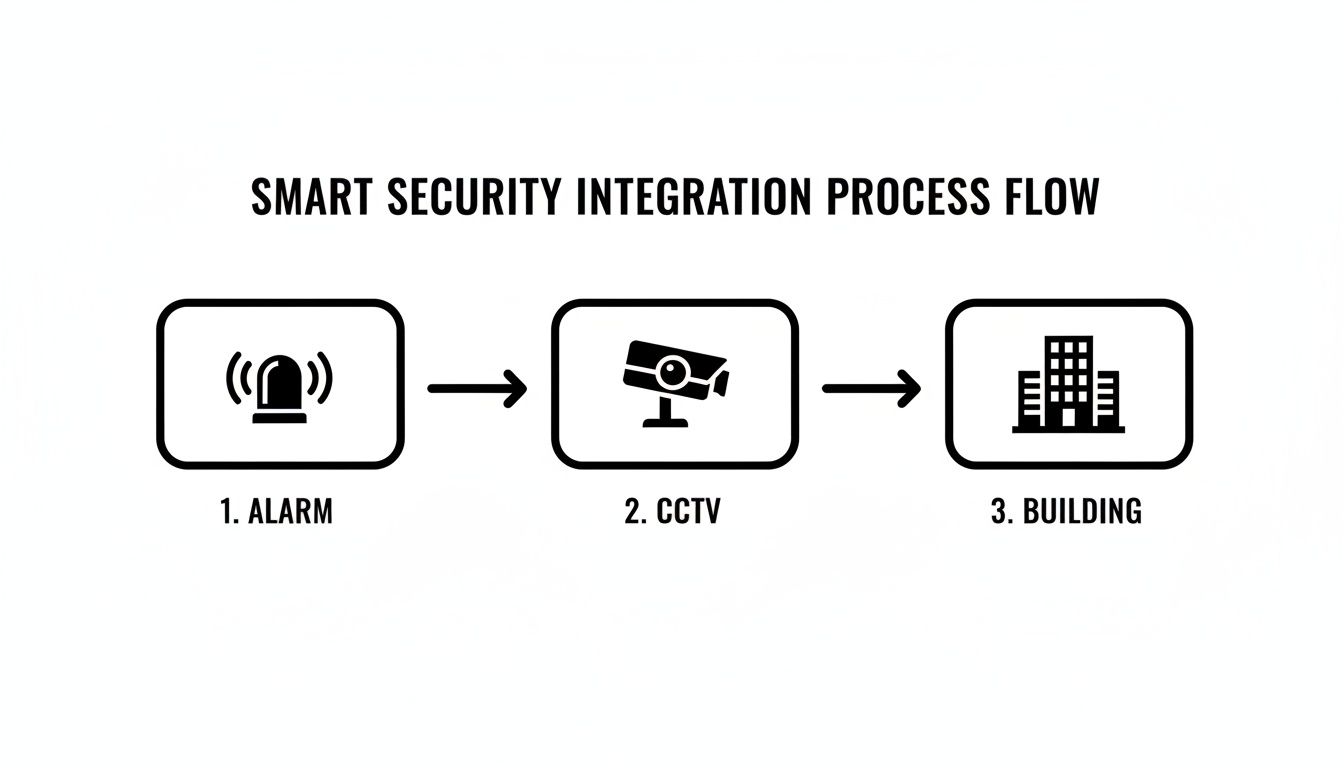
This simple flow shows the magic of integration: an alarm trigger doesn't just end there. It kicks off a series of actions that verify the threat and secure the building itself.
The Benefits of a Connected System
Getting these different technologies talking to each other provides some very real advantages beyond a quicker reaction. Once the alarm is in, the next logical step is figuring out how it can work with your other security layers. You can achieve a much more robust defence by exploring effective methods for integrating security systems and building a truly resilient solution.
One of the biggest wins is centralised control. Your site manager no longer has to jump between different apps and platforms for alarms, cameras, and doors. Everything can be managed from a single, unified interface. This is a massive boost for efficiency and dramatically cuts down the risk of human error when the pressure is on. For a more detailed look at the practicalities, it's worth learning about professional security system integration and what it can do.
Integration is the shift from just reacting to an alarm to intelligently managing a security event. It gives you the context—the "what's actually happening"—to make critical decisions in an instant, turning raw data into actionable intelligence.
Ultimately, a unified approach means your new intruder alarm isn't just another box on the wall. It becomes the central nervous system of a smarter, more responsive security strategy that makes your entire building work to protect itself.
From Plan to Protection: The Installation and Commissioning
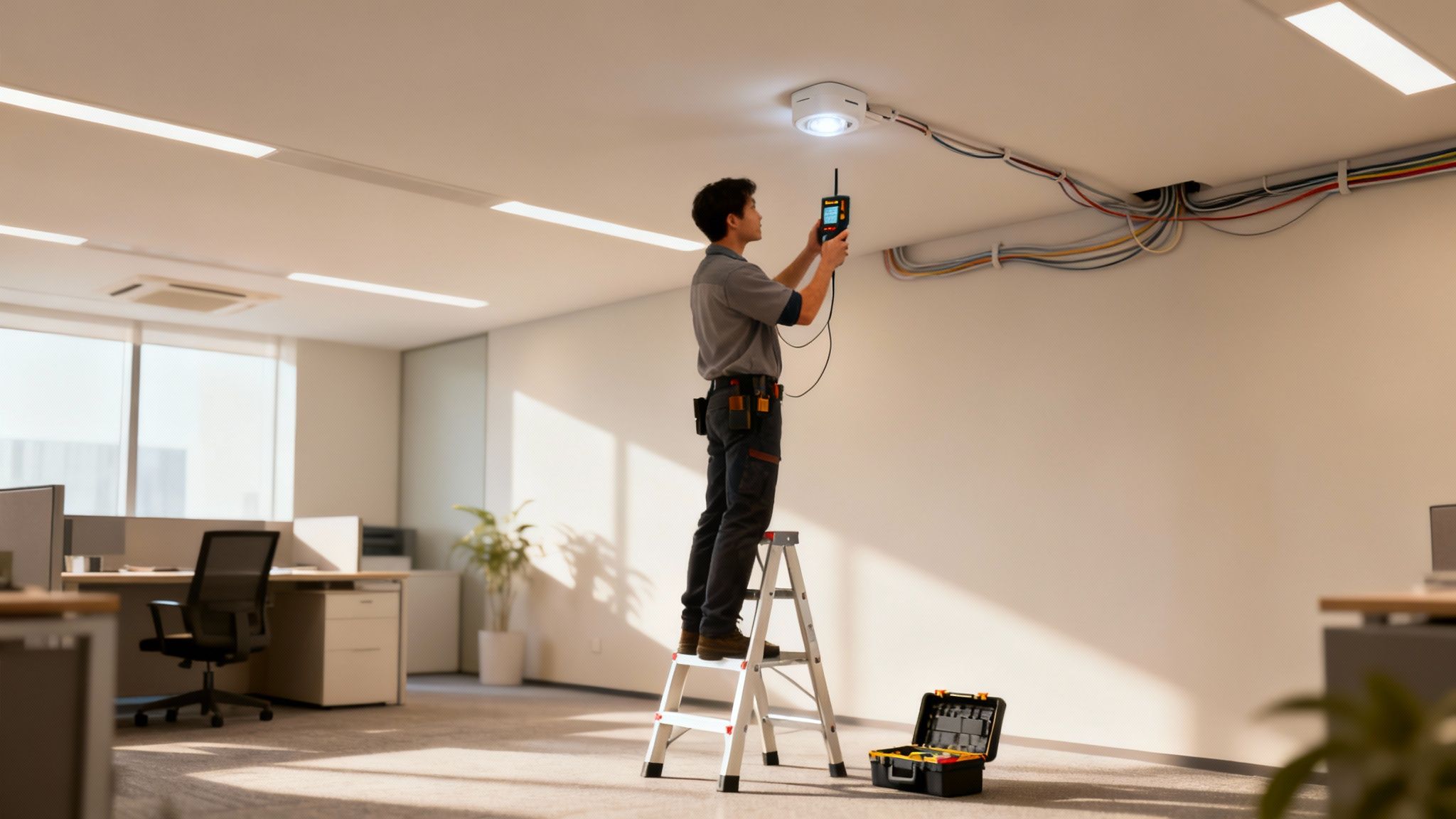
With a solid design in your back pocket, it's time to bring the blueprint to life. This is where the skill of the installer truly shines, turning technical drawings into a working system with as little disruption to your day-to-day operations as possible. For any busy commercial site, that's non-negotiable.
The physical installation is a painstaking process. It's so much more than just screwing devices to walls. A professional engineer takes immense pride in their work, focusing on neat, discreet cable runs. They'll often spend the extra time to hide wiring within ceiling voids or wall cavities to keep your building's aesthetics clean and professional.
This obsessive attention to detail applies to every single component. Sensor placement, for instance, is absolutely vital. I've seen countless DIY jobs where a PIR detector is placed opposite a radiator or in a patch of direct sunlight—a rookie mistake that’s a one-way ticket to constant false alarms. An experienced tech knows these environmental quirks and positions each device for peak performance, all while adhering strictly to the relevant British Standards.
The Critical Commissioning Checklist
Once every device is fitted and wired up, the job isn't done. Not even close. Now comes commissioning—the make-or-break final testing phase that proves every part of the system works exactly as it should. Skipping this is a risky shortcut that no professional would ever take.
A proper commissioning process is incredibly thorough. Your engineer should be methodically working through a detailed checklist that includes:
- Full Detector Test: Every sensor is individually triggered, from the front door contact to the vibration detector on the storeroom window, to confirm the control panel sees it.
- Breach Simulation: The engineers will actively try to defeat the system by walking through detection zones and opening protected doors to verify an immediate and correct alarm response.
- Monitoring Signal Verification: If the system is monitored, a test signal is sent to the Alarm Receiving Centre (ARC). The engineer then speaks directly with the ARC operator to confirm they received the signal and that it contains the correct zone information.
- Power Failure Test: The mains power is deliberately cut. The goal is to see the system switch flawlessly to its backup battery supply with zero interruption in protection.
This isn't about ticking boxes. It's about proving the system's resilience under real-world conditions, giving you absolute confidence it will perform when it matters most.
Commissioning transforms a collection of security hardware into a proven, reliable system. It's the final quality check that guarantees your investment will deliver genuine protection when you need it most.
Handover and Essential User Training
The final piece of the puzzle is the handover. This is the point where the engineers formally pass the keys to you and your team. A proper handover is far more than just a user manual and a handshake.
It should always involve comprehensive training, tailored to the people who will be using it. Your staff might only need to know how to set and unset the system. A manager, on the other hand, will need more in-depth knowledge on how to interpret zone alerts, manage user codes, and reset the system after an activation.
You should be left with clear, detailed documentation, including a system logbook, an accurate zone plan, and, crucially, the official certificate of compliance. This paperwork is vital for your own records, for your insurer, and for any future maintenance. A thorough handover ensures your team is confident from day one, turning the new system into an integral and effective part of your site's security.
Why Proactive Maintenance Is Your Best Defence
Getting a new intruder alarm installed is a great first step, but the job isn't finished once the engineers leave. Think of it this way: your alarm system is only ever as good as its last check-up. Without regular, professional maintenance, even the most sophisticated setup can quietly degrade, leaving you with a false sense of security.
It's easy to see maintenance as just another expense, but that's a mistake. It's really an ongoing investment in your protection. Ignoring it can lead to disaster, from the system failing during an actual break-in to finding out your insurance policy is void right when you need to make a claim. Regular servicing keeps your system dependable, compliant, and ready for anything.
What a Professional Contract Should Cover
A proper maintenance contract is far more than a quick look-see. It’s a comprehensive plan to keep every part of your system working perfectly.
At a minimum, you should expect:
- Routine Physical Inspections: An engineer should physically check every component—detectors, control panels, and cabling—for any signs of damage, wear, or tampering.
- Battery Health Checks: The backup battery is crucial. It needs to be tested under load to make sure it will kick in during a power cut. Weak batteries are one of the biggest points of failure.
- Sensor Calibration and Testing: Every single sensor needs to be tested to ensure it's detecting genuine threats accurately, which also helps prevent frustrating false alarms.
- Software and Firmware Updates: Modern alarm systems run on software. Just like your phone or computer, they need regular updates to fix security holes and add new features.
Neglecting maintenance is like owning a high-performance car but never changing the oil. Sooner or later, a small, preventable issue will lead to a catastrophic failure. With a security system, that failure could be devastating.
The numbers don't lie. A shocking one in three intruder alarms in the UK fails to activate during a break-in, often because of poor upkeep. This contributes to over £1 billion in losses every year. You can read more about these startling UK fire and security statistics on twenty-4.co.uk. It drives home the point that the initial installation is just the beginning of the story.
Ultimately, having professionals look after your system is the only way to ensure it remains reliable for years to come. A dedicated plan for commercial security system maintenance is the best way to protect your investment and make certain your property is secure 24/7. It’s a proactive step that maintains your system’s integrity, minimises false alarms, and keeps you on the right side of your insurers.
Your Intruder Alarm Questions, Answered
Deciding on a new security system naturally brings up a few questions. Here are some of the most common things clients ask us about the installation process.
How Long Will the Installation Take?
There’s no one-size-fits-all answer here, as it really depends on the scale of the job. For a typical family home, a straightforward wireless alarm system can often be installed and fully operational in less than a day.
On the other hand, a large commercial warehouse needing a complex, multi-zone wired system with extensive cabling could take a week or more. Our priority is always to get the job done right, with as little disruption to your home life or business operations as possible.
Will My Pets Set Off the Alarm?
This is probably one of the top questions we get, and it's a valid concern. The good news is, modern technology has this sorted. We use special pet-immune PIR sensors that are cleverly designed to ignore movement from animals under a certain weight and size.
During the initial site survey, we’ll pinpoint the best detectors for your space and calibrate them correctly. This means your dog or cat can wander around freely without you having to worry about false alarms.
A professionally installed system should be a source of peace of mind, not a nuisance. It all comes down to selecting the right equipment for your specific environment—and that absolutely includes factoring in any furry occupants.
Ultimately, the system should fit seamlessly into your world, not the other way around.