When you're searching for the best monitored alarm systems in the UK, what you’re really looking for isn't just technology—it's the professional response behind it. A top-tier system isn't just about the box on the wall; it’s the combination of reliable equipment with 24/7 human oversight from an accredited Alarm Receiving Centre (ARC). This ensures every single alert gets immediate, expert attention.
What Makes a Monitored Alarm System So Crucial?
Think of a standard, unmonitored alarm as a car horn blaring in an empty car park. Sure, it’s noisy, but it’s entirely dependent on a random passer-by noticing and deciding to do something about it.
A monitored system, on the other hand, is a direct, verified line to a team of security professionals. Their entire job is to respond, day or night.
This is the fundamental difference that turns a security device into a guaranteed response service. The moment your alarm is triggered, a signal shoots directly to an ARC. There, a trained operator analyses the data to verify the threat, filter out false alarms, and take decisive action.
The Power of a Guaranteed Response
The real value of a monitored alarm is that a confirmed emergency gets an immediate, appropriate response. This brings several critical benefits that a "bells-only" system simply can't offer:
- Rapid Emergency Service Dispatch: For a confirmed break-in, the ARC contacts the police directly with a verified report. This usually bumps it up the priority list. The same goes for fire alerts—the fire brigade is dispatched without a moment's delay.
- Intelligent False Alarm Filtering: Experienced operators follow strict protocols to check if an alarm is genuine, often by contacting designated keyholders first. This simple step prevents unnecessary callouts for minor issues, like the cat triggering a sensor, and protects your property's police response status. Too many false alarms can get your status downgraded or even withdrawn.
- Insurance Compliance and Savings: Many UK insurers insist on professionally installed and monitored alarm systems, particularly for commercial properties and high-value homes. Meeting this requirement often means you’ll see a welcome reduction in your insurance premiums.
A Growing Need for Proactive Security
It’s no surprise that the demand for professional monitoring is on the rise. In the UK, the security system services industry has grown steadily, with revenues now hitting an estimated £1.9 billion. This growth is largely fuelled by an increase in property crimes, which makes the swift response of a monitored alarm more vital than ever for anyone serious about protecting their premises.
A monitored alarm system closes the gap between detection and action. It’s the assurance that when something happens, a professional is always watching and ready to act on your behalf, providing genuine peace of mind that your property is protected around the clock.
Ultimately, choosing a monitored system is an investment in certainty. It's an indispensable tool for proactive risk management, ensuring that if your security is ever breached, the right people are notified instantly. You can learn more about how modern intruder alarm systems can be tailored to your specific needs.
Understanding Different Types of Alarm Monitoring
When it comes to your alarm system, the type of monitoring you choose is arguably the most critical decision you'll make. It’s what separates a system that just makes noise from one that guarantees a professional response. The right choice hinges on your property's specific risks, your budget, and, quite often, what your insurance company insists upon.
Think of it as choosing the right communication line for a crisis call. You need to be certain that the message will get through to the Alarm Receiving Centre (ARC), no matter what.
Let's walk through the main technologies available here in the UK, starting with the foundational options and building up to the high-resilience systems needed for more demanding environments.
The flowchart below cuts right to the chase: a monitored alarm triggers a real-world response, while an unmonitored one is all too easily ignored.
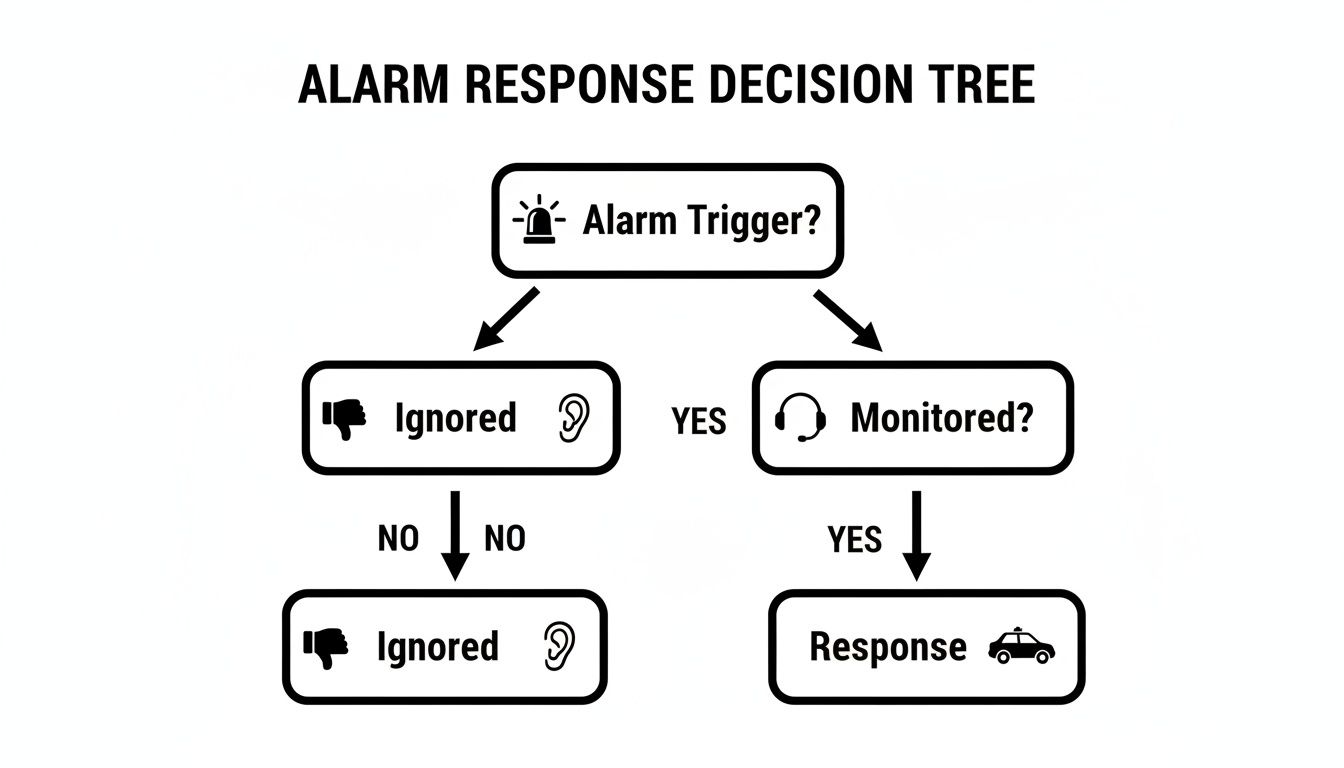
Ultimately, monitoring is the bridge between a sensor being triggered on-site and the emergency services being dispatched to your door.
Single-Path Monitoring Communication
As the name suggests, a single-path system relies on one single method to send its alarm signals. While they might sound basic, modern single-path systems provide a reliable and effective layer of security for many homes and small businesses with standard risk levels.
There are two main flavours of single-path monitoring you’ll find in the UK:
- IP Monitoring: This route sends signals down your existing broadband connection. It’s incredibly fast and generally cost-effective, but its Achilles' heel is your internet connection. If the Wi-Fi goes down or a cable is cut, the signal path is broken.
- Mobile Network Monitoring: This uses a dedicated SIM card to communicate over a mobile data network, just like your smartphone. It's a fantastic standalone option because it’s completely independent of your property’s phone lines or broadband.
A single-path system is a massive leap forward from a simple 'bells-only' alarm. However, that single point of failure means it might not tick the boxes for higher-risk premises where insurers demand more robust solutions.
Dual-Path Monitoring: The Gold Standard
For any high-risk commercial site, a business holding valuable stock, or any property where the insurance policy dictates the highest security grade, dual-path monitoring isn't just a recommendation—it's essential. You can think of it as having both a motorway and a reliable A-road for your alarm signals to travel on. If one gets blocked, the other is ready to go.
Dual-path monitoring ensures that if one communication channel fails—whether due to an accidental fault or deliberate tampering—a second, independent path is immediately available to transmit the alert. This built-in redundancy is what makes it so resilient.
This robust approach typically combines two distinct technologies, like an IP/broadband line backed up by a mobile network communicator. If an intruder is savvy enough to cut the phone line, the mobile path instantly takes over. If there's a temporary outage on the local mobile mast, the broadband path ensures the signal still gets to the ARC. This level of resilience is precisely what’s needed to secure a police Unique Reference Number (URN) for high-grade systems, guaranteeing a police response when you need it most. Exploring the full capabilities of professional remote monitoring systems shows just how powerful this layered protection can be.
To give you a clearer picture of how these technologies stack up, we've put together a simple comparison.
Comparison of UK Alarm Monitoring Technologies
The table below breaks down the main communication technologies used in the UK, comparing their resilience, common applications, and the level of police response they typically qualify for.
| Monitoring Type | Communication Path(s) | Resilience Level | Typical UK Application | Police Response Level |
|---|---|---|---|---|
| Digital Communicator | Standard Telephone Line | Low | Legacy domestic systems (being phased out) | Low / Keyholder Only |
| Single-Path IP | Broadband / IP Network | Medium | Low-risk commercial, residential properties | Medium / Level 1 |
| Single-Path Mobile | Mobile Network (GPRS/4G/5G) | Medium-High | Locations without broadband, good primary monitoring | Medium / Level 1 |
| Dual-Path IP/Mobile | Broadband and Mobile Network (GPRS/4G/5G) | High | High-risk commercial, required for insurance compliance | High / Level 1 |
As you can see, the move towards IP and mobile paths offers far greater security, with dual-path systems providing the ultimate peace of mind for businesses where a security breach is simply not an option.
Navigating UK Regulations and Compliance
For a monitored alarm system to be effective in the UK, it can't just make a noise. It has to meet a precise set of legal and industry standards that guarantee its performance and, crucially, ensure the emergency services will actually respond when you need them. This isn't just about ticking boxes; it's about making sure your investment delivers a reliable, verified response in a real emergency.
When you're looking at monitored alarms, it's vital to get your head around the specific UK regulatory compliance that applies to your business. Getting this right from the start means your system will be fit for purpose and recognised by both the police and your insurers.
Think of it this way: the entire framework is designed to build a system of trust. Police forces are inundated with alarm activations, and these standards help them instantly separate genuine emergencies from the thousands of false alarms. It makes the whole process safer and more efficient for everyone.
The Key UK Security Standards
At the heart of UK alarm compliance are a handful of critical standards. These codes dictate everything from the quality of the equipment right through to the procedures followed by the monitoring centre. They’re the rulebook that everyone in the professional security industry has to play by.
Here are the essential regulations you absolutely need to know:
- BS EN 50131: This is the bedrock European standard for intruder and hold-up alarms. It classifies systems into four security grades, from Grade 1 (low risk, like a typical home) up to Grade 4 for the highest-risk sites, such as banks or military facilities.
- PD 6662: This is the UK’s own version of the European standards. It lays out the scheme for installing and maintaining intruder alarms and is the key document governing whether a system qualifies for a police response.
- BS 8243: This standard gets into the nitty-gritty of systems that need police response. It covers everything from installation and maintenance to the specific protocols the Alarm Receiving Centre (ARC) must follow to minimise false alarms.
These standards all work in tandem, creating a robust and reliable security ecosystem. When a system is labelled 'compliant', you know it has met a very high benchmark for performance.
Why Your System Needs a Unique Reference Number
A Unique Reference Number (URN) is the golden ticket for getting the police to attend an alarm activation. Issued by the local police force, a URN is assigned to a specific monitored security system that meets all the required standards.
A URN acts as a direct link between your property's alarm system and the police control room. When your ARC reports a confirmed activation from a system with a URN, the police treat it as a priority incident, significantly speeding up their response time. Without a URN, you are reliant on a keyholder attending and dialling 999 themselves.
To get and keep a URN, your system must be installed and maintained by an accredited company and monitored by a recognised ARC. It’s simply a non-negotiable for any business that wants a guaranteed police response.
The Role of NSI and SSAIB Accreditation
So, how can you be sure an installer or monitoring centre actually meets these strict standards? This is where the independent inspectorates come in. In the UK, the two main bodies are the National Security Inspectorate (NSI) and the Security Systems and Alarms Inspection Board (SSAIB).
These organisations audit security companies to ensure they’re adhering to all the relevant British and European standards. You’ll find that insurance companies almost universally require any monitored alarm system to be installed and maintained by an NSI or SSAIB accredited firm. It’s their guarantee that the system is professionally designed, correctly installed, and reliably monitored. You can find out more by exploring the importance of industry accreditations for security providers.
This regulatory framework is a major reason the UK's alarm monitoring market is so robust. It's part of a wider European trend where monitored alarms are projected to grow to 23.9 million units by 2028. Here at home, monitoring services are a huge slice of the £1.9 billion security services revenue, largely driven by regulations that demand professional systems in commercial and public buildings.
Ultimately, compliance is just a practical necessity. Take a high-value retail store, for instance. An insurer will almost certainly mandate a Grade 3 dual-path system installed by an NSI Gold company. This isn't just about fulfilling a clause in a policy; it's a strategic risk management decision to ensure the business is properly protected when it matters most.
Integrating Your Alarm with Other Security Systems
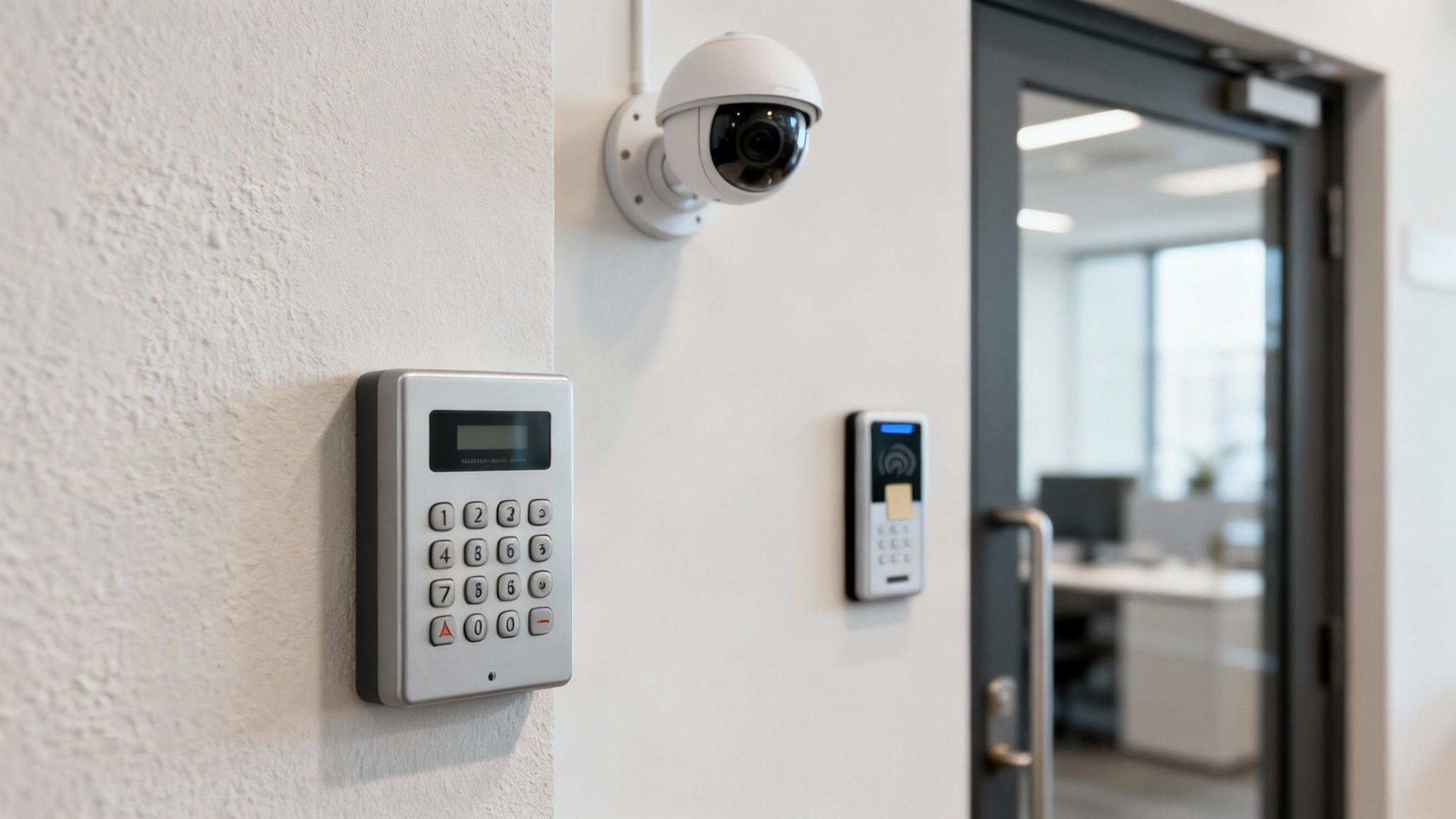
A monitored alarm on its own is a fantastic deterrent, but its real power is unlocked when you treat it as the central hub of a complete security setup. Think of it less as a single instrument and more as the conductor of an orchestra. By connecting it with other systems like CCTV and access control, you turn a simple alert into a rich, detailed story of exactly what’s happening on your premises.
When these systems talk to each other, they stop being isolated tools and start working in concert. This unified approach creates a smarter, faster, and far more effective response to any potential threat.
Thankfully, modern IP-based security equipment is built for this kind of teamwork. These systems use your existing network to share data, making it easier than ever to build a cohesive security shield. The payoff is huge: you get centralised control and a real-time, bird's-eye view of your entire property.
Combining Alarms with CCTV for Visual Verification
Pairing your monitored alarm with your CCTV network is one of the smartest moves you can make. This combination takes your security from simply detecting a breach to seeing it as it happens.
Let's say a sensor is triggered—a door contact on a warehouse shutter, for example. Instead of just sending a silent signal, the integrated system can spring into action automatically.
- Pinpoint the Intrusion: The nearest Pan-Tilt-Zoom (PTZ) camera can instantly swivel to focus on the exact spot where the alarm was triggered.
- Send Proof to the ARC: A short, high-definition video clip of the event is automatically sent straight to the Alarm Receiving Centre (ARC).
- Go Live: Monitoring operators get immediate access to the live camera feed to see what’s going on for themselves.
This is what we call visual verification, and it’s a game-changer. It gives the monitoring team concrete proof of a genuine intrusion. They can then report a "crime in progress" to the police, which dramatically bumps up the priority and speed of the police response.
This link also makes it incredibly easy to filter out false alarms. If a camera shows that a stack of boxes simply fell over and triggered a sensor, the ARC can stand down without bothering you or dispatching anyone, protecting your police response status.
Unifying Access Control and Intruder Alarms
When you connect your alarm to your access control system, you gain a powerful way to manage site security and react dynamically to incidents. You can control who goes where, but crucially, you can also automatically lock the site down in an emergency.
Picture a break-in attempt after hours. The moment the intruder alarm goes off, the system can trigger a pre-planned lockdown.
- Trap the Intruder: All external doors and roller shutters can be instantly locked to contain the threat.
- Protect Key Assets: Internal doors to high-value areas like server rooms or stockrooms can be secured to stop them from getting any further.
- Create a Digital Trail: The system will log any further attempts to use key fobs or cards, giving investigators a clear audit trail of the intruder's movements.
This kind of automated response is a massive boost for protecting your assets and keeping people safe, especially on larger, more complex sites. For vulnerable areas like car parks, this layered approach is vital; as this complete car park protection guide explains, combining alarms with cameras, lighting, and physical barriers creates a much tougher defence. The principle is exactly the same: integrated systems always work better than isolated ones.
What's the Real Cost of a Monitored Alarm?
When you’re thinking about getting one of the UK’s best monitored alarm systems, it’s easy to focus on the initial price tag. But the true investment—the total cost of ownership—is a blend of upfront costs and the ongoing services that keep your premises secure day in, day out. Getting a grip on these different elements helps you budget properly and see the genuine value your system provides over its lifetime.
Think of it as three main pieces of a financial puzzle. Each one is crucial for making sure your security is always on, compliant, and ready to act.
The Upfront Investment: Equipment and Installation
This is your biggest initial outlay. It covers all the physical kit—the sensors, panels, and communicators—and, just as importantly, the expert labour needed to get it all installed and working perfectly. The final figure can swing quite a bit depending on your specific needs.
- System Grade: Under the BS EN 50131 standard, alarms are graded from 1 (low risk) to 4 (high risk). A Grade 3 system for a high-value jeweller's will naturally cost more than a Grade 2 system for a small office because it demands more advanced, tamper-proof hardware.
- Property Size & Layout: A sprawling warehouse with dozens of doors and windows needs far more sensors than a compact retail shop. The building's layout and even its construction materials can add to the complexity and time needed for installation.
- Choice of Technology: A resilient dual-path monitoring setup, which uses both an internet (IP) and a mobile signal, costs more initially than a single-path system but offers a vital backup if one line goes down.
The Ongoing Service: Monthly Monitoring Fees
Once the system is in, the monitoring fee kicks in. This recurring cost is what you pay for the 24/7 vigilance of an Alarm Receiving Centre (ARC). It's the service that turns a simple alarm bell into a powerful, professionally managed security response.
This fee is your subscription to peace of mind. It covers the highly trained operators, advanced infrastructure, and secure communication links needed to scrutinise every alert, verify threats, and dispatch the emergency services when necessary.
You'll usually pay this monthly or quarterly. The price can vary based on the level of service; for example, a system that includes visual verification from CCTV cameras will cost more to monitor than a standard intruder-only alarm because it involves more hands-on analysis from the ARC team.
Keeping it Sharp: The Annual Maintenance Contract
This isn't just a nice-to-have; a professional maintenance contract is essential. It's a non-negotiable for keeping your police response status active and a firm requirement for most business insurance policies. This annual fee is your guarantee that the system stays reliable and up to standard.
A typical contract includes at least one scheduled visit a year from a qualified engineer who will:
- Test every single detector, sensor, and communication link.
- Check the health of all batteries and backup power.
- Update the system’s firmware to patch any security gaps.
- Give you a full report to keep for your compliance records.
This proactive care is what stops small faults from becoming big problems and helps prevent the disruption of false alarms.
To give you a clearer idea, here are some typical cost breakdowns for different types of properties in the UK.
Estimated Total Cost of Ownership for Monitored Alarms in the UK
This table provides illustrative cost breakdowns for different types of UK properties, covering initial setup, monitoring, and maintenance.
| Property Type | Initial Installation Cost (£) | Annual Monitoring Fee (£) | Annual Maintenance Contract (£) |
|---|---|---|---|
| Small Retail Unit | £800 – £2,000 | £250 – £450 | £150 – £250 |
| Medium Office | £2,500 – £6,000 | £400 – £700 | £300 – £500 |
| Large Warehouse | £7,000 – £15,000+ | £600 – £1,200+ | £500 – £900+ |
Remember, these are just ballpark figures. The final cost will always depend on a detailed risk assessment of your specific property and operational needs.
How to Choose the Right Security Partner
Let's be blunt: the most sophisticated alarm system on the market is practically useless without the right team behind it. Choosing the company that designs, installs, and monitors your system is the single most important decision you'll make. It’s where the technology meets real-world expertise.
This choice ties everything together—compliance, system integration, and the long-term reliability you're paying for. A genuine security partner doesn’t just shift boxes; they deliver a complete service. It starts with a real conversation about your specific challenges and ends with the peace of mind that someone is always watching over your premises.

Look for Proven Expertise and Accreditation
Before you even look at a brochure, check for accreditations. This is your first and most effective filter. In the UK, the gold standards are approvals from the National Security Inspectorate (NSI) or the Security Systems and Alarms Inspection Board (SSAIB). These aren't just fancy logos for a website; they are hard-won proof that a company meets stringent British and European standards.
NSI Gold or SSAIB certification isn't just a "nice-to-have"—it's the benchmark for competence and trust in our industry. It guarantees the provider is skilled, regularly audited, and committed to doing things properly. For many insurers, it's simply non-negotiable.
Working with an accredited installer is the only way to be certain your system is compliant, reliable, and, crucially, eligible for a police response when you need it most.
A Partnership Approach to Security
The best security companies operate less like salespeople and more like specialist consultants. They know that no two properties are the same and that your operational needs are unique. Their process should be built around you.
Look for a provider who follows a clear, consultative path:
- Initial Site Survey: A proper risk assessment on your premises, not just a quote over the phone. They need to walk the ground to find the weak spots.
- Bespoke System Design: Crafting a solution that fits your risks like a glove, incorporating everything from dual-path signalling to CCTV and access control integration.
- Flawless Installation: Work carried out by qualified engineers who are meticulous about their craft, ensuring every sensor and connection is perfect.
- Proactive Monitoring: A seamless handover to their own accredited, 24/7 Alarm Receiving Centre (ARC) staffed by trained professionals.
- Ongoing Maintenance: A clear service plan to keep the system working perfectly and ensure it remains compliant year after year.
You’re not just buying an alarm; you’re looking for a partner who acts as an extension of your own team. They should provide a solution that works from day one and can grow with your business. This is what separates the merely adequate from the best monitored alarm systems in the UK.
Ultimately, security is one of the most critical investments you'll make. Choosing a partner who can deliver a truly comprehensive, end-to-end solution is the only way to get the genuine peace of mind you’re after.
Your Questions, Answered
When you're looking into monitored alarms, a few practical questions always come up. Here are some straightforward answers to the queries we hear most often from UK home and business owners.
What Happens If I Accidentally Set Off My Alarm?
Don't worry, it happens to the best of us. Accidental triggers are handled with a clear, established protocol designed to avoid sending the police to a false alarm.
As soon as the alarm goes off, the Alarm Receiving Centre (ARC) gets the signal. Their first step isn't to dispatch anyone, but to call you or your designated keyholders. They'll ask for a pre-agreed password or duress code to verify your identity.
If you confirm it was a mistake, they simply cancel the alert. This verification process is a crucial part of the PD 6662 standard and is essential for keeping your police response level active. It’s a simple but effective filter for genuine human error.
Can I Switch My Current Alarm System To a Different Monitoring Company?
In most cases, yes, you can. If you have an existing intruder alarm from a well-known manufacturer, a professional security company can usually take over the monitoring.
It all starts with a system survey. A qualified engineer will visit to check your system's age, condition, and whether it still meets current standards like BS EN 50131. If everything checks out, they can simply reprogramme the alarm's communicator to send signals to their own NSI Gold approved monitoring centre.
Should any components be outdated or non-compliant, they’ll explain what needs upgrading to ensure the system is reliable and meets the necessary standards for monitoring.
This approach means you can often keep your existing hardware, saving you the cost of a full replacement while still getting the benefit of an accredited, top-tier monitoring service.
Will a Monitored Alarm Reduce My Insurance Premiums?
It certainly can. Having a professionally installed and monitored alarm from an NSI or SSAIB accredited firm is a big plus for insurers. They see it as a significant reduction in risk, and many will offer a noticeable discount on your premiums as a result.
For businesses and high-value homes, it often goes beyond a simple discount. Many insurance policies will actually require a professionally monitored alarm as a condition of their cover. Without one, you risk your policy being invalidated if you ever need to make a claim, which makes it a critical investment in your overall protection.
At Amax Fire & Security Ltd, we specialise in designing and installing bespoke monitored security systems that meet the highest UK standards. Contact us today for a free consultation to secure your property with a trusted partner.