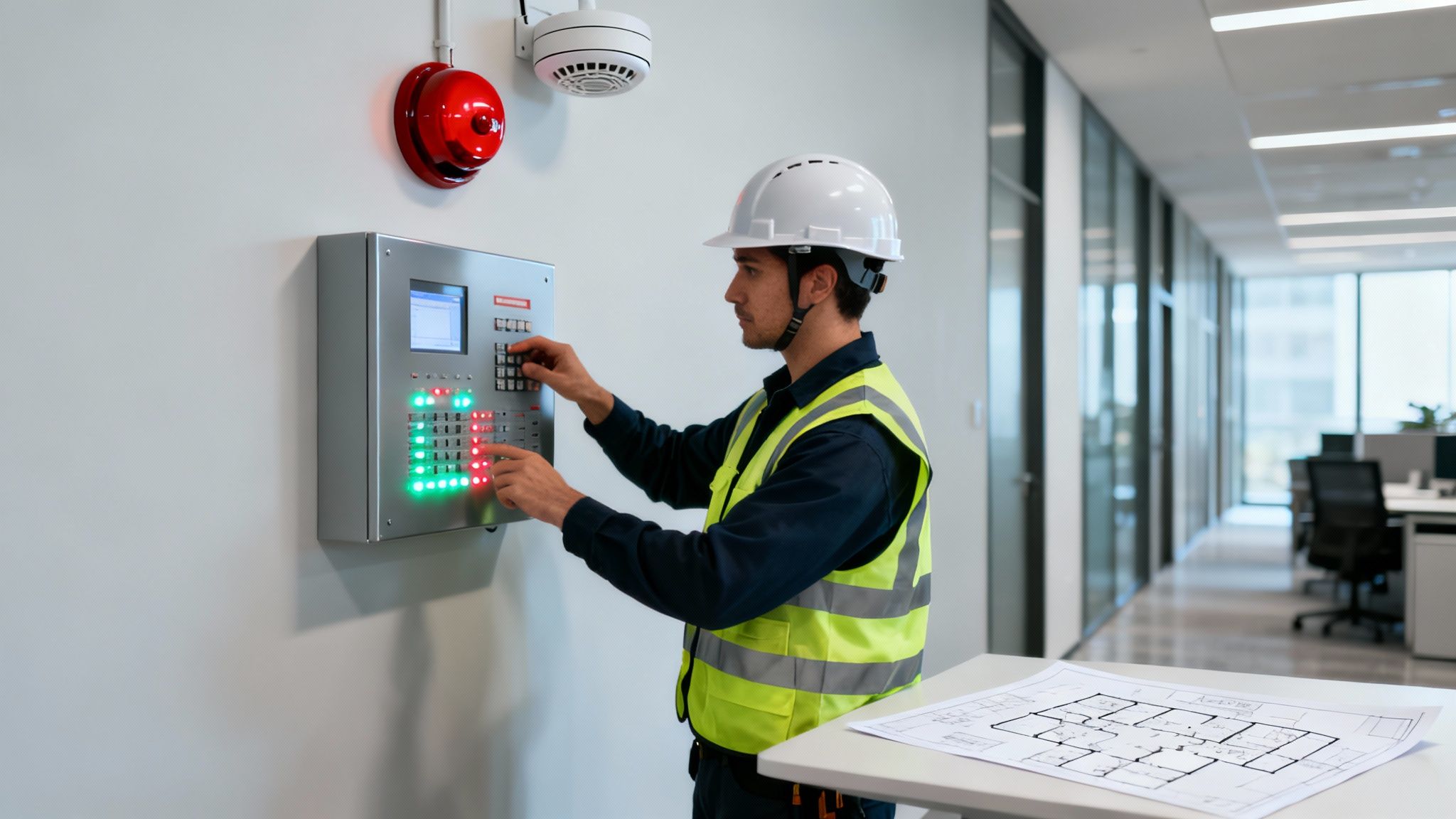
Getting to grips with fire safety regulations in the UK isn’t about just memorising a rulebook. It's about cultivating a deep-seated, proactive mindset to protect people and property. The legal framework is designed to put the responsibility squarely on the shoulders of building owners and managers, tasking them with assessing real-world dangers and putting solid safety measures in place.
Understanding the UK’s Fire Safety Legal Framework
Today’s approach to fire safety didn't just appear out of thin air. It's the direct result of painful lessons learned from history that have fundamentally reshaped our laws on building and public safety. The regulations we follow now are far less about rigid, one-size-fits-all mandates and much more about a continuous, dynamic process of managing risk.
For anyone in charge of a building—be it a facilities manager, landlord, or business owner—understanding this evolution is crucial. It’s a complete shift in thinking, moving away from a simple box-ticking exercise towards actively engineering a safe environment from the ground up. This proactive responsibility is the very heart of current legislation.
The Evolution from Disaster to Diligence
Throughout history, major disasters have always been the unfortunate catalyst for legal change. Think back to the Great Fire of London in 1666. That single event wiped out over 13,200 houses and left something like 80% of the city as smoking ruins. The response from King Charles II was to demand new buildings be made of brick or stone, not wood, and that streets be made wider. These were some of the very first government-led steps in fire safety planning.
This cycle of learning from tragedy has continued right into the modern day. The core principle that has emerged is simple but powerful: the people who control a building are in the best position to understand and manage the specific fire risks within it.
The Shift to a Risk-Based System
The legal framework we have today marks a massive departure from the confusing, piecemeal laws of the past. Gone are the days when a fire authority would simply issue a certificate. Now, the law places the burden of responsibility on a designated 'Responsible Person' within any organisation.
This individual (or team) has a clear legal duty to:
- Carry out a detailed and specific fire risk assessment for the premises.
- Put in place and consistently maintain the right fire safety measures.
- Develop a clear, practical plan for what to do in an emergency.
- Ensure all staff receive proper fire safety information and training.
For landlords, this legal framework includes specific obligations like securing mandatory gas safety documents, such as the annual Landlord CP12 Certificates. This just goes to show how wide-ranging and comprehensive these duties really are.
At its core, the UK's entire fire safety system is built on one word: accountability. The law makes it crystal clear that the person or people running a property are legally on the hook for the safety of everyone inside. This transforms compliance from a passive, once-a-year task into an active, ongoing duty of care.
Who's in Charge? The 'Responsible Person' and the Law of the Land
The bedrock of fire safety in the UK today is a single, powerful piece of legislation: The Regulatory Reform (Fire Safety) Order 2005. If you're involved in managing any kind of non-domestic premises, this is your bible. It wasn't just another update; it was a total reset, designed to cut through a dangerously tangled web of old rules.
Before 2005, trying to figure out your fire safety obligations was a nightmare. Businesses had to grapple with a patchwork of over 80 different laws – everything from the Fire Precautions Act 1971 to various old Factory Acts. The 2005 Order swept all that away for England and Wales, replacing it with one, common-sense framework. The old system of rigid, prescriptive fire certificates was scrapped. In its place came a much more dynamic, risk-based approach, which went live on 1 October 2006. The new non-negotiable? A thorough fire risk assessment.
At the very heart of this law lies the concept of the ‘Responsible Person’. This isn't just a title to put on a business card; it's a legal designation that comes with some very serious weight and personal liability. The law is crystal clear about who carries this burden.
So, Who is the Responsible Person?
Pinpointing the Responsible Person is the absolute first step. Get this wrong, and everything that follows is built on shaky ground. The law doesn't leave much room for ambiguity; the role typically falls to:
- The Employer: If it's a workplace, the employer is almost always the one in the hot seat.
- The Owner: For empty buildings or certain other situations, the legal owner holds the responsibility.
- The Person in Control: This could be a facilities manager, a building manager, or a managing agent – essentially, anyone with a degree of control over the premises.
It's also crucial to understand that responsibility can be shared. In a multi-tenanted office block, for example, the landlord and each individual business are all Responsible Persons. In these cases, the law demands they cooperate and coordinate to ensure the entire building is safe. It's in this context that professional property managers often take a leading role in navigating the full scope of property manager responsibilities.
What Does the 2005 Order Actually Demand?
The duties that come with this role are extensive and they are not optional. They’re designed to weave a comprehensive safety net that protects absolutely everyone who sets foot in the building. This is about moving away from a tick-box mentality and towards proactive, continuous safety management.
The legal duty of the Responsible Person isn't to create a zero-risk environment—that’s impossible. It’s to take every reasonable step to bring fire risk down to an acceptable level. This makes fire safety a constant process, not a job you do once and forget about.
We can break down these core legal duties into a handful of key actions.
The Essential Responsibilities Checklist
As the Responsible Person, you are legally required to carry out and regularly review the following to stay compliant with fire safety regulations in the UK:
- Conduct a Fire Risk Assessment: This is the cornerstone of everything. You must methodically identify the fire hazards, figure out who is at risk, and then act to either remove or reduce those risks.
- Implement and Maintain Safety Measures: Your risk assessment will dictate what's needed. This means installing and, just as importantly, maintaining things like fire alarms, extinguishers, fire doors, and emergency lighting.
- Create an Emergency Plan: You need a clear, simple, and well-rehearsed plan that everyone understands, detailing exactly what to do if a fire breaks out.
- Provide Information and Training: It's not enough to have the right gear; you must ensure staff and other relevant people (like fire marshals) are given clear instructions and training on the fire safety procedures.
- Keep Records: If you have five or more employees, you must record the significant findings of your risk assessment, the safety measures you've put in place, and your emergency plan. This paperwork is your proof of diligence.
Dropping the ball on any of these duties can have life-altering consequences. We're talking unlimited fines and, in the worst-case scenarios, a prison sentence. The law puts the burden squarely on the Responsible Person to prove they did everything reasonably possible to keep people safe.
Your Step-by-Step Guide to Fire Risk Assessments
A fire risk assessment isn’t a one-off task you can just tick off a list, file away, and forget about. Far from it. This is the living, breathing heart of your entire fire safety strategy. It’s mandated by UK law, and as the Responsible Person, it’s your legal and moral duty to get it right.
This methodical process is how you systematically uncover potential dangers, work out the actual risks they pose, and take decisive action to protect the people and property in your care.
Think of it less like a test and more like creating a detailed map of your premises. A good map shows you exactly where you are, points out potential hazards along your journey, and plots the safest routes. A thorough fire risk assessment does precisely the same for your building's safety, giving you a clear, actionable plan that stands up to scrutiny and, most importantly, works when it matters most.
The journey to our current system has been a long one. The timeline below shows how UK fire safety law has evolved, moving away from a complex web of different rules towards the modern, risk-based approach we use today.
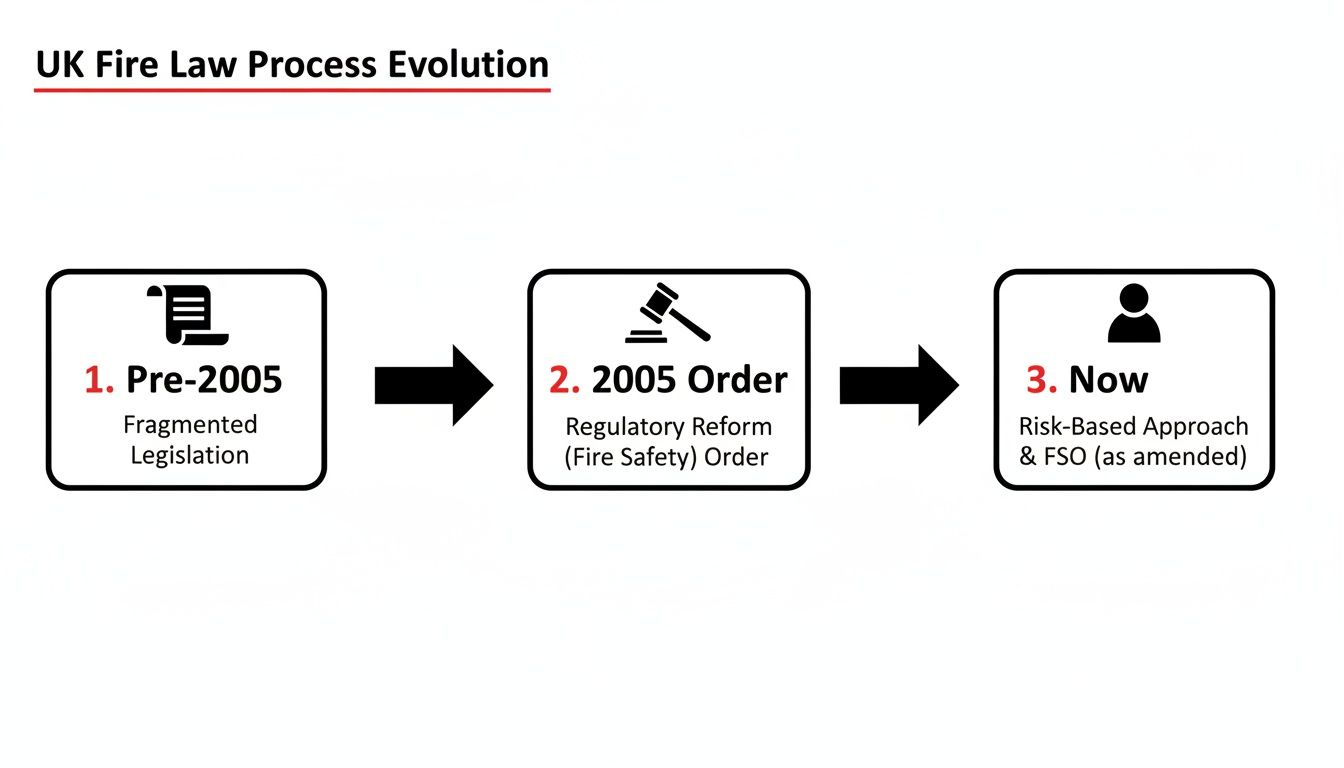
This shift from old-fashioned, prescriptive certificates to personal responsibility is exactly why conducting a detailed fire risk assessment is now the absolute cornerstone of compliance.
The Five Core Steps of a Fire Risk Assessment
The Health and Safety Executive (HSE) lays out a straightforward, five-step process. Following these stages ensures your assessment is comprehensive, logical, and fully compliant. Each step builds on the last, creating a rock-solid framework for managing fire safety day in, day out.
To make this clear, here’s a quick overview of what each step involves.
The Five Steps of a Fire Risk Assessment
| Step Number | Action Required | Key Considerations |
|---|---|---|
| Step 1 | Identify the Fire Hazards | Walk through the premises to find sources of ignition (e.g., faulty wiring, heaters), fuel (e.g., paper, waste, furniture), and oxygen. |
| Step 2 | Identify People at Risk | Think beyond a simple headcount. Consider lone workers, visitors, the public, and anyone with mobility issues who may need extra help. |
| Step 3 | Evaluate and Reduce Risks | Act on your findings. Remove hazards where possible. If not, implement control measures to mitigate the risk to a 'reasonably practicable' level. |
| Step 4 | Record, Plan, and Train | Document all significant findings if you have 5+ employees. Use this to create a clear emergency plan and train everyone on what to do. |
| Step 5 | Review and Update Regularly | This is a live document. Review it at least annually, or immediately after any significant changes to the building, processes, or staffing. |
These steps provide the structure, ensuring you don't miss anything critical. Let's dig into what each one means in practice.
Step 1: Identify the Fire Hazards
Your first job is to walk the premises with a critical eye. You're hunting for anything that could either start a fire or help it spread. This needs a methodical approach – you have to check everywhere, from the boiler room to the back office.
Hazards generally fall into three buckets:
- Sources of Ignition: Anything that can create a spark or heat. Think faulty electrical gear, portable heaters, naked flames in kitchens, or even discarded cigarettes.
- Sources of Fuel: All the combustible materials that could feed a fire. This includes the obvious stuff like paper, cardboard, and flammable liquids, but also the less obvious culprits like textiles, furniture, and rubbish that hasn't been cleared away.
- Sources of Oxygen: While oxygen is all around us, you need to flag any areas with an enhanced supply, like medical gas stores in a hospital or certain chemical storage areas.
Step 2: Identify People at Risk
Once you've mapped out the physical hazards, you need to think about who might be harmed. This is more than just counting heads. You need to consider where people are and when they are there, paying close attention to anyone who might be especially vulnerable.
Be sure to consider groups like:
- Employees working in isolated areas or lone workers.
- Visitors and contractors who don't know the layout.
- Members of the public, particularly in busy areas.
- Anyone with mobility challenges, disabilities, or other conditions that might slow them down in an evacuation.
Step 3: Evaluate, Remove, and Reduce the Risks
Now for the action part. Using what you’ve learned from the first two steps, you must decide what to do about each risk you’ve identified. The top priority is always to remove the hazard completely. If that's just not possible, you have to put measures in place to control the risk and lessen its potential impact.
The legal benchmark here is what is ‘reasonably practicable’. Nobody expects you to create a 100% risk-free environment, but you absolutely must take all sensible and proportionate steps to reduce the chances of a fire and limit its severity if one does break out.
This involves a mix of physical fixes and procedural changes. For instance, if you find overloaded extension leads, the solution is to install more fixed sockets. If flammable waste is piling up, the control is to implement a strict daily disposal routine. For bigger jobs, you might need specialist help, which is where knowing your health and safety project requirements is crucial.
Step 4: Record, Plan, and Train
This step is non-negotiable. If you have five or more employees, you are legally required to record the significant findings of your assessment. This written record is your proof of compliance. It needs to detail the hazards you found, who is at risk, and what you’ve done about it.
This record then becomes the foundation of your emergency plan. That plan must lay out crystal-clear procedures for detecting a fire, raising the alarm, and getting everyone out safely. Finally, you have to provide clear information and training to all your staff on these procedures, ensuring everyone knows exactly what to do in an emergency.
Step 5: Review and Update Regularly
Your fire risk assessment is a dynamic document, not something to be put on a shelf and forgotten. The law requires you to review it regularly to make sure it's still fit for purpose. Best practice is to review it at least once a year, or immediately if anything significant changes.
A "significant change" could be anything from alterations to the building layout, introducing a new work process that uses hazardous materials, or a big shift in the number of people on-site. This constant cycle of review and update ensures your safety measures evolve right alongside your organisation.
Essential Fire Safety Systems and Maintenance Schedules
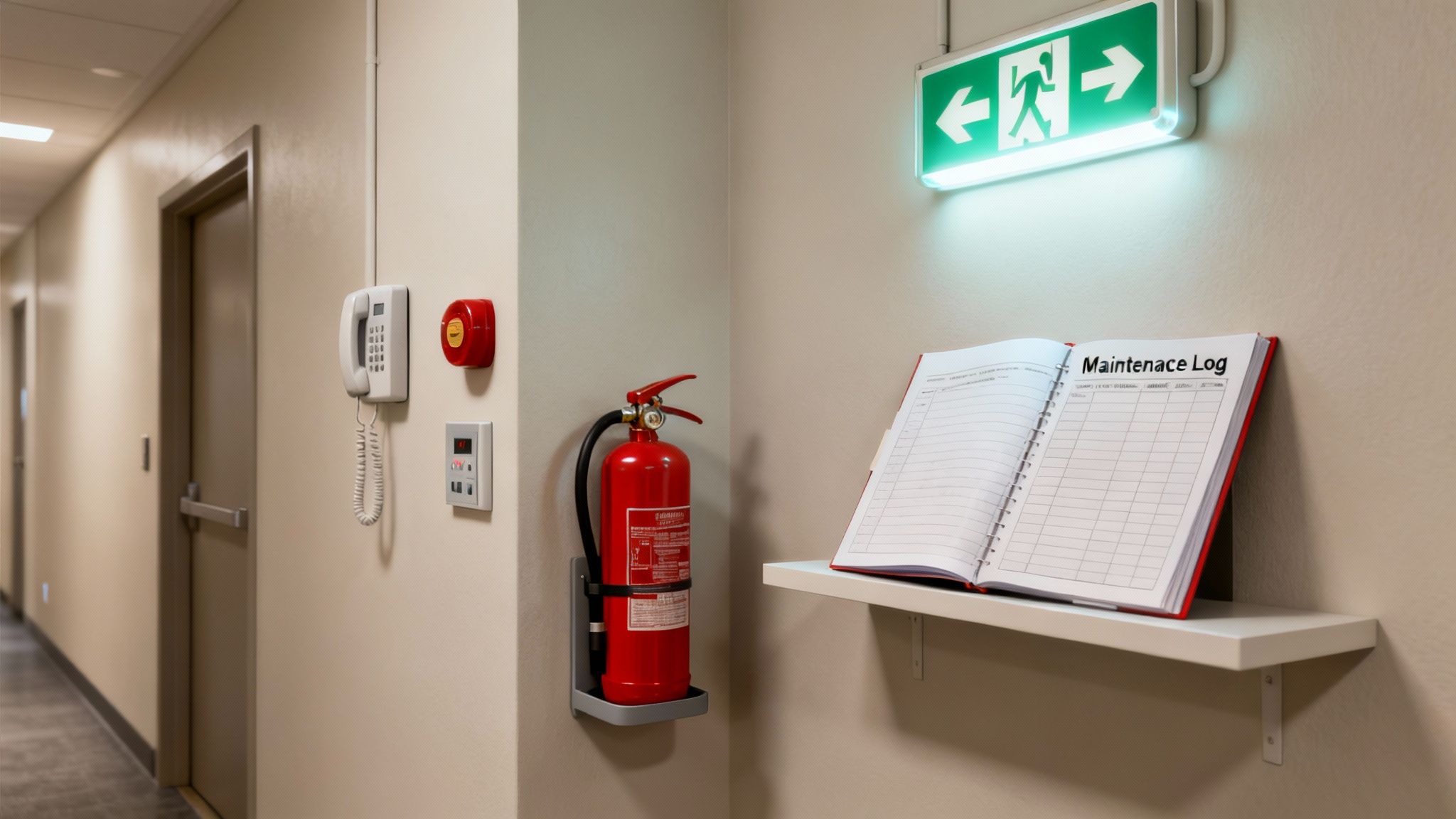
Getting your fire risk assessment signed off is a critical first step, but it’s just that—the start. Real, tangible safety is engineered into your building through a network of active and passive fire protection systems. These aren't just 'nice-to-haves'; they are the essential tools required by fire safety regulations uk to spot danger early, help people get out, and contain a fire before it can take hold.
Think of these systems as a highly coordinated emergency response team. Your alarms are the lookouts, shouting a warning at the first sign of trouble. The emergency lights and fire doors are the marshals, creating a clear and protected path to safety. And the fire extinguishers? They're your first responders, ready to tackle a small blaze before it escalates into a full-blown disaster.
But here’s the crucial part: installing this equipment and then forgetting about it is not an option. These systems must be meticulously maintained so they work flawlessly when you need them most. This isn't just best practice; it's a legal duty that rests squarely on the shoulders of the Responsible Person.
Fire Detection and Alarm Systems
The very first line of defence in any fire situation is a dependable detection and alarm system. Its job is incredibly simple but profoundly important: give everyone the earliest possible warning of a fire, buying precious time for a safe and orderly evacuation.
The rulebook for these systems is BS 5839, the British Standard that details everything from design and installation to commissioning and ongoing maintenance. The type of system you need isn't one-size-fits-all; it depends entirely on your building's size, its day-to-day use, and what your fire risk assessment has uncovered.
A fire alarm that doesn't work when needed isn't just a faulty bit of kit—it's a catastrophic failure to protect human life. The only way to ensure it will do its job when seconds are critical is through regular, professional maintenance.
The maintenance schedule is strict and must be properly recorded. A weekly test of a manual call point by someone on your team is the bare minimum. Beyond that, a competent, certified engineer must conduct a full service at least every six months, inspecting every single component from the detectors and panels down to the backup batteries to guarantee the entire system is ready to go.
Emergency Lighting Systems
When a fire trips the power and plunges a building into darkness, confusion and panic can set in almost instantly. This is where emergency lighting becomes a lifesaver. It’s designed to kick in automatically, illuminating escape routes, exits, and stairwells to guide people calmly and safely out of the building.
The standard you need to know here is BS 5266. It specifies exactly where emergency lights are needed, how bright they must be, and how long they need to stay on. It covers everything from ensuring a minimum light level along a corridor to pinpointing the location of fire extinguishers and alarm call points.
Just like your alarms, this system needs regular attention:
- Monthly: A quick functional check (often called a "flick test") where you simulate a power cut to ensure the lights switch on correctly.
- Annually: A full duration test. This is where the system is left to run on its batteries for its entire rated period—usually one or three hours—to make sure the batteries can still hold a full charge.
Fire Extinguishers and Fire Doors
While alarms and lighting are all about getting people out, other systems are there to manage the fire itself. These fall into two camps: active measures you use (like extinguishers) and passive measures that work automatically (like fire doors).
Fire extinguishers must be the right type for the specific fire risks in each area (e.g., water, foam, CO2), positioned where they can be seen, and easy to grab. Under BS 5306, a designated person on-site should give them a quick visual check every month, but a certified technician must carry out a full service at least once a year.
Fire doors are perhaps the unsung heroes of fire safety. As a core part of your building's passive fire protection, their job is to create compartments that hold back flames and smoke for a set time (often 30 or 60 minutes). This protects escape routes and stops a fire from spreading rapidly. They only work if they’re in perfect condition, never propped open, and their heat-activated intumescent seals are intact. Regular checks for damage to the door, frame, and the all-important self-closing mechanism are absolutely vital.
Integrating these fire safety measures is a fundamental part of robust health & safety management systems, helping to build a comprehensive safety culture. Working with a certified specialist ensures this life-saving equipment isn't just installed, but is kept in peak condition, ready to perform without question when it matters most.
Navigating Sector-Specific Fire Safety Challenges
The bedrock principles of fire safety are universal, but how you apply them on the ground can change dramatically depending on what a building is used for. A cookie-cutter approach to fire safety regulations in the UK isn’t just ineffective, it’s a fast track to non-compliance. The law is very clear: the Responsible Person must get to grips with the unique risks their specific environment presents.
Let's be practical. The fire safety strategy for a hospital, full of vulnerable patients who can't just get up and leave, is going to be worlds away from that of a data centre, where protecting priceless equipment is almost as critical as protecting life. Getting these nuances right is what separates a tick-box exercise from a fire safety plan that actually works.
Protecting Vulnerable Occupants in Healthcare and Education
When you're dealing with places like hospitals, care homes, or schools, the duty of care goes up several notches. The building's occupants might be children, elderly residents, or patients with serious mobility issues, which makes a standard "everybody out" fire drill completely unworkable.
The strategy here pivots to progressive horizontal evacuation. Think of it as moving people in managed stages, from a room or area of immediate danger to an adjacent, fire-safe compartment on the very same floor. This buys precious time for staff to move people safely without triggering a chaotic, full-scale building evacuation. It's a strategy that leans heavily on rock-solid passive fire protection—perfectly maintained fire doors and fire-resistant walls are absolutely essential to create these temporary safe havens.
Managing Crowds in Theatres and Large Venues
Big public spaces like theatres, concert halls, and stadiums throw a completely different set of problems at you. You have huge numbers of people, most of whom have never been in the building before, often in low lighting. Add the potential for panic, and you have a high-risk cocktail.
For these places, fire safety is all about active crowd management:
- Phased Evacuation: This is a bit like the horizontal evacuation in hospitals, but it’s all about managing the flow of people. Announcements might direct specific seating blocks or floors to leave in a controlled sequence, preventing dangerous stampedes and bottlenecks at the exits.
- Robust Emergency Lighting: Escape routes must be lit up like a runway, leaving absolutely no doubt where to go, even if the main power cuts out.
- Drilled and Ready Staff: Venue staff and stewards are your front line. They need to be rigorously trained in crowd control and evacuation procedures, ready to guide the public to safety calmly and effectively.
In a public venue, your fire safety plan is never passive. You can't just put up a few signs and hope for the best. Your staff are a critical part of the life safety system, responsible for directing and reassuring hundreds or even thousands of people under intense pressure.
Specialised Rules for Houses in Multiple Occupation (HMOs)
Houses in Multiple Occupation (HMOs) are a special case. These are residential properties where tenants from different households share facilities like kitchens or bathrooms. They are considered higher-risk by default—you often have more people, complex layouts, and occupants who might not be as fire-aware. As a result, they come under much stricter fire safety rules.
Local authorities set specific licensing conditions for HMOs, which almost always demand a higher grade of fire detection and alarm system (typically a mains-powered system with all alarms interlinked) than you'd find in a standard family home. Fire doors on individual rooms and clear, well-lit escape routes are usually non-negotiable. The landlord, as the Responsible Person, has to ensure these tougher measures are not just fitted, but meticulously maintained.
Protecting Critical Assets in Data Centres
While protecting people will always be the number one priority, data centres add a crucial second objective: safeguarding the mission-critical IT infrastructure inside. For many businesses, a fire that destroys their servers is an extinction-level event.
This dual challenge calls for highly specialised fire suppression systems. A traditional water sprinkler system could easily cause as much damage as the fire it's supposed to be putting out. That's why data centres rely on solutions like inert gas or chemical agent suppression. These systems work by rapidly reducing the oxygen in the room or chemically stopping the fire in its tracks, extinguishing it in seconds without harming the sensitive electronic equipment. Understanding the unique demands of these high-value environments is vital, and you can learn more about how tailored fire and security works for specialist sectors to see how the right system provides the best protection.
Understanding Enforcement and Maintaining Compliance
Knowing the law is one thing, but truly understanding the consequences of getting it wrong is what forces you to take action. When it comes to fire safety regulations uk, enforcement isn't a passive tick-box exercise. Your local Fire and Rescue Authority has the legal power to walk into your premises, inspect them, and come down hard if they find the Responsible Person has dropped the ball.
This isn't about getting a slap on the wrist. These authorities have real teeth. They can issue formal notices demanding you fix problems, and in the most serious cases, they can shut your building down on the spot if they think people's lives are in immediate danger. Ignoring your duties can land you in serious legal and financial hot water, which is why a proactive approach is the only sensible one.
The Powers of Fire and Rescue Authorities
When an inspector finds a breach, they have a range of tools to make you comply. The one they choose depends entirely on how serious they think the problem is.
Generally, you'll see one of three types of action:
- Alterations Notice: You'll get one of these if your building itself, or how it's being used, creates a serious risk. It essentially freezes any further changes to the building until you've made specific improvements.
- Enforcement Notice: This is the most common tool in their arsenal. It will clearly list what you’ve done wrong and give you a non-negotiable deadline to put it right.
- Prohibition Notice: This is the nuclear option, used only when an inspector believes there's a risk of death or serious injury. This notice can stop you from using part or all of your building until the issues are fixed.
Failing to comply with any of these notices is a criminal offence. That means you could be looking at unlimited fines and, for individuals, even a prison sentence. The courts do not take kindly to people who knowingly put lives on the line.
Building a Defensible Compliance Strategy
The secret to keeping inspectors at bay is to build a compliance system that you can prove is working. This goes way beyond just having the right kit installed; it's about creating a solid audit trail that shows you're taking safety seriously.
A strong compliance strategy is your best defence. It’s not about being perfect, but about being able to prove you have taken every reasonable step to identify, assess, and manage fire risks on your premises.
Meticulous record-keeping is your foundation. This means having your up-to-date fire risk assessment ready to go, along with records of every staff training session and detailed logs of every single maintenance check on your alarms, emergency lights, and extinguishers. Think of this paperwork not as a chore, but as your proof of diligence. Back this up with regular internal audits and fire drills to make sure your plans actually work in the real world, not just on paper.
Getting to this modern, risk-based approach has been a long road, built on older laws like The Fire Precautions (Workplace) Regulations 1997/1999. These were pivotal, shifting some of the burden from the fire brigade directly onto employers and laying the groundwork for the risk assessment model we rely on today, with the fire service acting as the ultimate enforcer. You can discover more insights about the history of fire safety regulation in the UK to understand how we got here. Ultimately, taking a proactive stance protects your business, your property, and most importantly, your people.
Your UK Fire Safety Questions Answered
Getting to grips with fire safety law can feel like navigating a maze. It's only natural for practical questions to pop up. Here, we'll tackle some of the most common queries we hear from facilities managers and business owners, offering straight-to-the-point answers to help you stay on the right side of the law.
How Often Should We Review Our Fire Risk Assessment?
The official guidance says you must review your fire risk assessment 'regularly', but what does that actually mean in practice? Think of it as a living document. Best practice, and what any inspector will expect to see, is a thorough review at least once a year.
That said, you can't just wait for the annual diary reminder. You need to conduct a fresh review immediately if anything significant changes. This could be anything from altering the building's layout, changing the use of a particular area, bringing in new, potentially hazardous materials, or, of course, after any fire-related incident, no matter how small. Staying on top of it ensures your safety plan is never out of date.
Who Exactly is the 'Responsible Person'?
This is a crucial one. The ‘Responsible Person’ is the individual or entity who is legally on the hook for fire safety on the premises. In most workplaces, it's straightforward: the employer holds that duty. In other buildings, it's whoever has control, which could be the owner or the main occupier.
It gets a little more complex in buildings with multiple tenants. In those cases, responsibility is often shared between the landlord, the building's facilities management team, and even the individual businesses leasing space. The deciding factor always comes down to control—if you have the authority to manage fire safety systems and procedures in an area, you're likely a Responsible Person.
Are the Fire Rules the Same Across the UK?
No, they aren't, and this is a common pitfall. While the general principle of using a risk-based approach is the same everywhere, the specific laws you need to follow depend on where your property is located.
It's vital you're working from the correct playbook for your region:
- In Scotland, your go-to legislation is the Fire (Scotland) Act 2005 and its related regulations.
- In Northern Ireland, the legal framework is set by the Fire and Rescue Services (Northern Ireland) Order 2006 and the Fire Safety Regulations (Northern Ireland) 2010.
Always make sure you're referencing the specific fire safety regulations uk for the country you operate in. Getting this wrong can completely undermine your compliance efforts.
At Amax Fire & Security Ltd, we're here to cut through the confusion. Our accredited experts provide the guidance and services you need to ensure your fire and security systems are fully compliant, giving you genuine peace of mind. To talk through your specific needs and build a safety strategy that truly protects your premises, take a look at our solutions at https://amaxfireandsecurity.co.uk.